
Ingenious Mower User
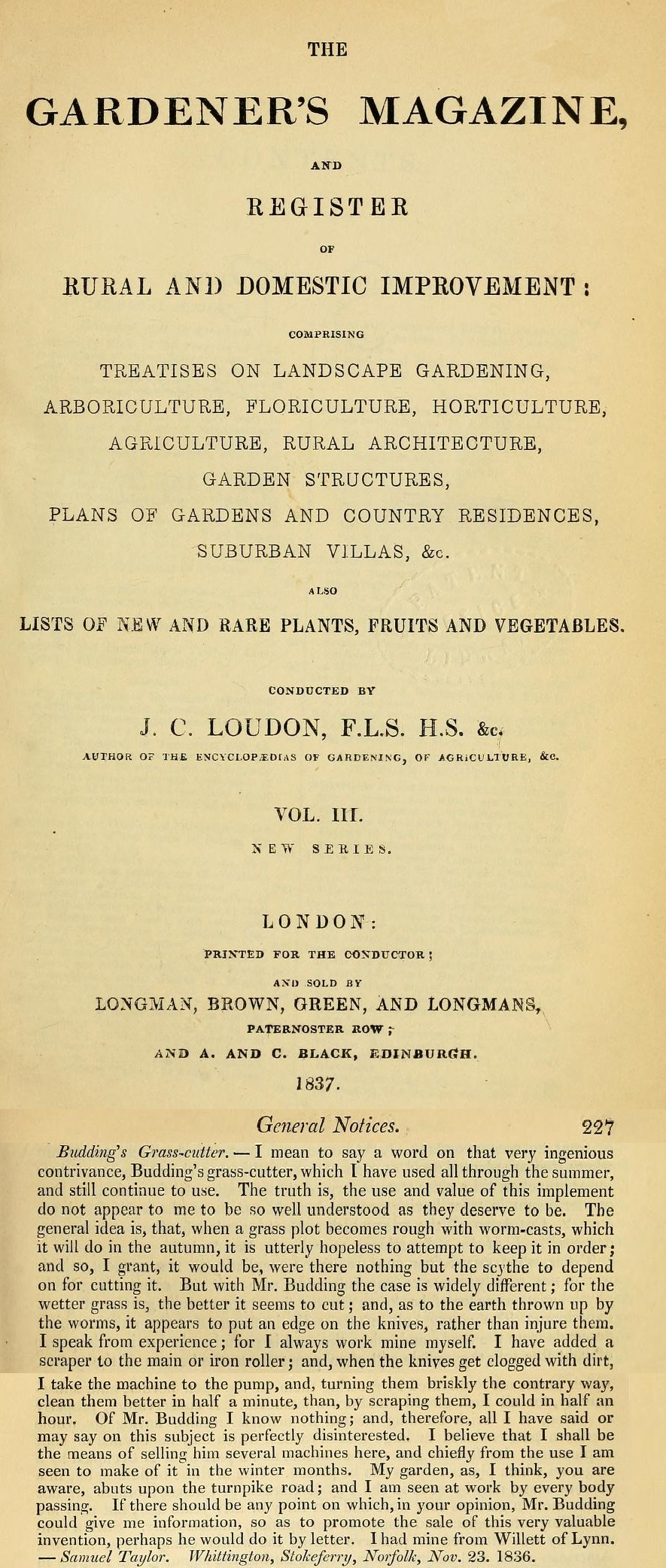
In a letter to The Gardener's Magazine in November 1836, Samuel Taylor of Norfolk seems to have identified some features of the lawn mower that had not been mentioned before.
He writes that the earth from worm casts caught up in the mower's blades seems to put an edge on them, in other words making (or keeping) them sharp. Early reports of the mower made no mention of this, or indeed any form of sharpening, although no doubt skilled artisans used to working with knives and other such implements would have known how to do it. Nevertheless, the idea of abrasive earth putting a sharp edge on the blade might now be seen as early form of two techniques that were later used widely to maintain lawnmowers: grinding and backlapping. With grinding, the cutting cylinder is rotated against a grind wheel turning in the opposite direction and moving along its length to create or renew a sharp edge. Backlapping is the practice of applying abrasive paste to the edge of the rotating blades and then turning the cylinder against the bottom (fixed or ledger) blade to maintain a sharp edge.
Samuel Taylor also reports that he has modified his lawnmower with the addition of a scraper to the roller, presumably to the rear. The first machines did not have a scraper and this is perhaps the first mention of one being added. Although he does not say why explicitly, it is likely that the scraper was to remove any earth from worm casts stuck to the roller, forcing it to drop behind the machine and prevent it falling into the blades or mechanism.
He also mentions that he takes the "machine to the pump" to clean the cutters after use and that this is quicker than using a brush. In doing so he may have inadvertently invented the idea of using a "pressure washer" to clean a lawnmower, a now common practice.
THE
GARDENER'S MAGAZINE,
AND
REGISTER
OF
RURAL AND DOMESTIC IMPROVEMENT:
COMPRISING
TREATISES ON LANDSCAPE GARDENING,
ARBORICULTURE, FLORICULTURE, HORTICULTURE,
AGRICULTURE, RURAL ARCHITECTURE,
GARDEN STRUCTURES,
PLANS OF GARDENS AND COUNTRY RESIDENCES,
SUBURBAN VILLAS, &c.
ALSO
LISTS OF NEW AND RARE PLANTS, FRUITS AND VEGETABLES.
CONDUCTED BY
J. C. LOUDON, F.L.S. H.S. &c.
AUTHOR OF THE ENCYCLOPAEDIAS OF GARDENING, OF AGRICULTURE, &c.
VOL. III.
NEW SERIES.
LONDON:
PRINTED FOR THE CONDUCTOR;
AND SOLD BY
LONGMAN, BROWN, GREEN, AND LONGMANS,
PATERNOSTER ROW AND A. AND C. BLACK, EDINBURGH.
1837.
General Notices
Budding's Grass-cutter. — I mean to say a word on that very ingenious contrivance, Budding's grass-cutter, which I have used all through the summer, and still continue to use. The truth is, the use and value of this implement do not appear to me to be so well understood as they deserve to be. The general idea is, that, when a grass plot becomes rough with worm-casts, which it will do in the autumn, it is utterly hopeless to attempt to keep it in order; and so, I grant, it would be, were there nothing but the scythe to depend on for cutting it. But with Mr. Budding the case is widely different; for the wetter grass is, the better it seems to cut; and, as to the earth thrown up by the worms, it appears to put an edge on the knives, rather than injure them. I speak from experience; for I always work mine myself. I have added a scraper to the main or iron roller; and, when the knives get clogged with dirt, I take the machine to the pump, and, turning them briskly the contrary way, clean them better in half a minute, than, by scraping them, I could in half an hour. Of Mr. Budding I know nothing; and, therefore, all I have said or may say on this subject is perfectly disinterested. I believe that I shall be the means of selling him several machines here, and chiefly from the use I am seen to make of it in the winter months. My garden, as, I think, you are aware, abuts upon the turnpike road; and I am seen at work by every body passing. If there should be any point on which, in your opinion, Mr. Budding could give me information, so as to promote the sale of this very valuable invention, perhaps he would do it by letter. I had mine from Willett of Lynn.
Samuel Taylor. Whittington, Stokeferry, Norfolk, Nov. 23. 1836.PublicationGardeners MagazineDateSourceBiodiversity Heritage Library/Gardeners Magazine/1837/P227Link