
Mechanics Magazine Includes News About Shanks Mower
This piece refers to an earlier report in The Gardeners' Chronicle. There are brief details of another account on the pony mower introduced by Alexander Shanks of Arbroath, outside the English patent jurisdiction and noting John Ferrabee of Thrupp, Stroud and Edwin Budding. The article states that "Mr Ferraber is the agent for Mr Budding" when it should say that John Ferrabee was the sole licensed manufacturer for the Buddings Mower.
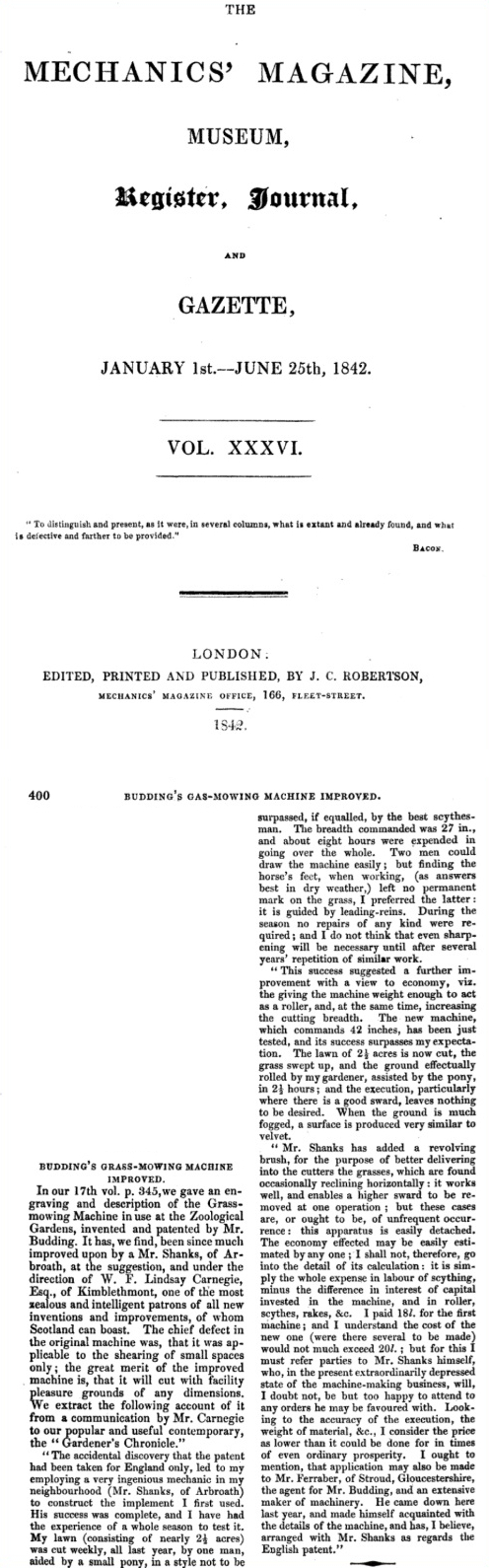
THE
MECHANICS' MAGAZINE,MUSEUM,
Register, Journal.
AND
GAZETTE,
JANUARY 1st - June 25th, 1842VOL. XXX VI
"To distinguish, as it were, in several columns, what is extant and already found, and what is defective and farther to be provided." Bacon
LONDON: EDITED, PRINTED AND PUBLISHED, BY J. C. ROBERTSON,
MECHANICS' MAGAZINE OFFICE, 166, FLEET-STREET.
1842BUDDING'S GRASS-MOWING MACHINE IMPROVED.
In our 17th vol. p. 395,we gave an engraving and description of the Grass-mowing Machine in use at the Zoological Gardens, invented and patented by Mr. Budding. It has, we find, been since much improved upon by a Mr. Shanks, of Arbroath, at the suggestion and under the direction of W. F. Lindsay Carnegie, Esq., of Kimblethmont, one of the most zealous and intelligent patrons of all new Inventions and improvements, of whom Scotland can boast. The chief defect in the original machine was, that it was applicable to the shearing of small spaces only; the great merit of the improved machine is, that it will cut with facility pleasure grounds of any dimensions. We extract the following account of it from a communication by Mr. Carnegie to our popular and useful contemporary, the "Gardener's Chronicle."
"The accidental discovery that the patent had been taken for England only, led to my employing a very ingenious mechanic in my neighbourhood (Mr. Shanks, of Arbroath) to construct the implement I first used. His success was complete, and I have had the experience of a whole season to test it. My lawn (consisting of nearly 2½ acres) was cut weekly, all last year, by one man, aided by a small pony, in a style not to be surpassed, if equalled, by the best scythesman. The breadth commanded was 27in., and about eight hours were expended in going over the whole. Two men could draw the machine easily; but finding the horse's feet, when working, (as answers best in dry weather,) left no permanent mark on the grass, I preferred the latter: it is guided by leading-reins. During the season no repairs of any kind were required; and I do not think that even sharpening will be necessary until after several years' repetition of similar work.
"This success suggested a further improvement with a view to economy, viz. the giving the machine weight enough to act as a roller, and, at the same time, increasing the cutting breadth. The new machine, which commands 42 inches, has been just tested, and its success surpasses my expectation. The lawn of 2½ acres is now cut, the grass swept up, and the ground effectually rolled by my gardener, assisted by the pony, in 2½ hours; and the execution, particularly where there is a good sward, leaves nothing to be desired. When the ground is much fogged, a surface is produced very similar to velvet.
"Mr. Shanks has added a revolving brush, for the purpose of better delivering into the cutters the grasses, which are found occasionally reclining horizontally: it works well, and enables a higher sward to be removed at one operation; but these cases are, or ought to be, of unfrequent occurrence: this apparatus is easily detached. The economy effected may be easily estimated by any one; I shall not, therefore, go into the detail of its calculation: it is simply the whole expense in labour of scything, minus the difference in interest of capital invested in the machine, and in roller, scythes, rakes, &c. I paid 18l. for the first machine; and I understand the cost of the new one (were there several to be made) would not much exceed 20l.; but for this I must refer parties to Mr. Shanks himself, who, in the present extraordinarily depressed state of the machine-making business, will, I doubt not, be but too happy to attend to any orders he may be favoured with. Looking to the accuracy of the execution, the weight of material, &c., I consider the price as lower than it could be done for in times of even ordinary prosperity. I ought to mention, that application may also be made to Mr. Ferrabee, of Stroud, Gloucestershire, the agent for Mr. Budding, and an extensive maker of machinery. He came down here last year, and made himself acquainted with the details of the machine, and has, I believe, arranged with Mr. Shanks as regards the English patent."
PublicationMechanics MagazineDateSourceWest Bengal Public Library/Internet Archive/Mechanics Magazine/VOL36/1842/P400Link