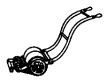
Mathers v Green - A Court Case
COURT CASE CONCERNING:
Thomas & Willoughby Green (the father and son of Thomas Green & Son of Leeds & London) were sued by Robert Mathers, an engineer at Thomas Green & Son.
The case was heard of January 16, 17 and February 14 in 1865, and was recorded as Mathers v Green.
Robert Mathers was an engineer at Thomas Green & Son of Leeds on a salary of £200 a year. He made a complaint of unfair financial benefits to the Greens. He accused them of taking the rewards for his inventions, such as the pinion chain (patented 1859) and subsequent joint patents between the said parties. He was in effect accusing the Greens of not sharing profits with him.
At the conclusion of this case the court adjudged that the a co-owner of a patent cannot exploit it exclusively without sharing profits if the other co-owner is legally blocked from using it themselves. This meant that the plaintiff, Richard Mathers, won the case against the defendants, father-and-son Thomas and Willoughby Green.
Mathers and the Greens jointly held patents for improvements to lawn-mowing machines. The Greens argued that Mathers had waived his rights in exchange for a salary, and that even as a co-owner, each partner could use a patent independently without sharing manufacturing profits.
The court rejected both arguments:
- No Waiver: There was no valid agreement proving Mathers gave up his ownership.
- Blocked Use: Normally, co-owners can each work a patent independently. However, these new improvements built directly upon an earlier mowing-machine patent owned solely by Willoughby Green. Because Mathers could not legally manufacture the improved machines without infringing Willoughby's prior patent, he was effectively locked out from using his own joint property.
Consequently, the judge ordered the Greens to pay Mathers one-third of all licensing royalties and one-third of the net profits exclusively attributable to the new improvements, alongside the commission owed for managing their London branch.
However, this was not the end of the matter. Later in 1865, Lord Chancellor Cranworth reversed Sir John Romilly's ruling on appeal (Mathers v. Green, L.R. 1 Ch. App. 29). While Lord Cranworth agreed that Richard Mathers remained a legitimate one-third co-owner of the patents (rejecting the Greens' claim that he had signed away his rights), he overturned the order requiring Thomas and Willoughby Green to share their manufacturing profits.
Lord Cranworth's reasoning was as follows:
- Risk vs. Reward: Lord Cranworth noted that if the Greens had lost money manufacturing the mowers, they could not have forced Mathers to share in the losses. Consequently, it would be unjust to let a non-working co-owner claim a share of the profits earned through another co-owner's capital, enterprise, and risk.
- No Fiduciary Duty: Co-patentees are not business partners by default. A patent grants the right to exclude the rest of the world—not a right to compel a co-owner to work the invention for everyone's mutual benefit.
- Prior Patent Irrelevant: The fact that Mathers could not practically build the improved machines without infringing Willoughby Green's earlier 1859 patent did not alter the legal nature of their joint ownership.
This was an important judgment. Mathers v. Green became the foundational precedent in English (and later Commonwealth and US) patent law: absent an agreement to the contrary, any co-owner of a patent may work the invention independently for their own sole benefit without accounting to the other co-owners for profits.
(Note: Under modern UK patent law—specifically Section 36 of the Patents Act 1977—this rule still holds for working the invention yourself, though a co-owner cannot grant licences or assign their share to third parties without the consent of the other co-owners.)
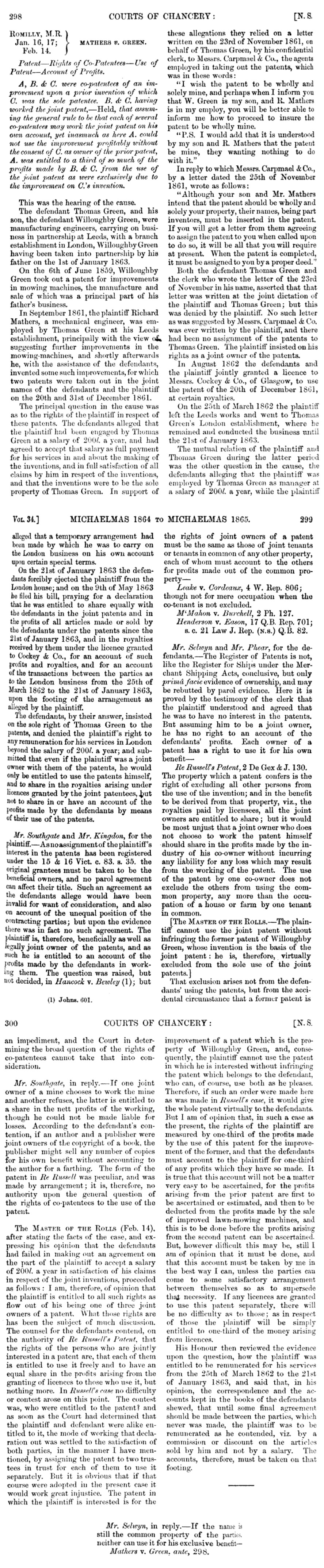
COURTS OF CHANCERY:
ROMILLY, M.R.
Jan. 16, 17;
Feb. 14. MATHERS v. GREEN.Patent Rights of Co-Patentees-Use of Patent-Account of Profits.
A, B. & C. were co-patentees of an improvement upon a prior invention of which C. was the sole patentee. B. & C. having worked the joint patent,-Held, that assuming the general rule to be that each of several co-patentees may work the joint patent on his own account, yet inasmuch as here A. could not use the improvement profitably without the consent of C. as owner of the prior patent, A. was entitled to a third of so much of the profits made by B. & C. from the use of the joint patent as were exclusively due to the improvement on C.'s invention.
This was the hearing of the cause.
The defendant Thomas Green, and his son, the defendant Willoughby Green, were manufacturing engineers, carrying on business in partnership at Leeds, with a branch establishment in London, Willoughby Green having been taken into partnership by his father on the 1st of January 1863.
On the 6th of June 1859, Willoughby Green took out a patent for improvements in mowing machines, the manufacture and sale of which was a principal part of his father's business.
In September 1861, the plaintiff Richard Mathers, a mechanical engineer, was employed by Thomas Green at his Leeds establishment, principally with the view of suggesting further improvements in the mowing-machines, and shortly afterwards he, with the assistance of the defendants, invented some such improvements, for which two patents were taken out in the joint names of the defendants and the plaintiff on the 20th and 31st of December 1861.
The principal question in the cause was as to the rights of the plaintiff in respect of these patents. The defendants alleged that the plaintiff had been engaged by Thomas Green at a salary of 2004. a year, and had agreed to accept that salary as full payment for his services in and about the making of the inventions, and in full satisfaction of all claims by him in respect of the inventions, and that the inventions were to be the sole property of Thomas Green. In support of these allegations they relied on a letter written on the 23rd of November 1861, on behalf of Thomas Green, by his confidential employed in taking out the patents, which clerk, to Messrs. Carpmael & Co., the agents was in these words:
"I wish the patent to be wholly and solely mine, and perhaps when I inform you that W. Green is my son, and R. Mathers is in my employ, you will be better able to inform me how to proceed to insure the patent to be wholly mine.
"P.S. I would add that it is understood by my son and R. Mathers that the patent be mine, they wanting nothing to do with it."
In reply to which Messrs. Carpmael & Co., by a letter dated the 25th of November 1861, wrote as follows:
"Although your son and Mr. Mathers intend that the patent should be wholly and solely your property, their names, being part inventors, must be inserted in the patent. If you will get a letter from them agreeing to assign the patent to you when called upon to do so, it will be all that you will require at present. When the patent is completed, it must be assigned to you by a proper deed."
Both the defendant Thomas Green and the clerk who wrote the letter of the 23rd of November in his name, asserted that that letter was written at the joint dictation of the plaintiff and Thomas Green; but this was denied by the plaintiff. No such letter as was suggested by Messrs. Carpmael & Co. was ever written by the plaintiff, and there had been no assignment of the patents to Thomas Green. The plaintiff insisted on his rights as a joint owner of the patents.
In August 1862 the defendants and the plaintiff jointly granted a licence to Messrs. Cockey & Co., of Glasgow, to use the patent of the 20th of December 1861, at certain royalties.
On the 25th of March 1862 the plaintiff left the Leeds works and went to Thomas Green's London establishment, where he remained and conducted the business until the 21st of January 1863.
The mutual relation of the plaintiff and Thomas Green during the latter period was the other question in the cause, the defendants alleging that the plaintiff was employed by Thomas Green as manager at a salary of 2004. a year, while the plaintiff alleged that a temporary arrangement had been made by which he was to carry on the London business on his own account upon certain special terms.
On the 21st of January 1863 the defendants forcibly ejected the plaintiff from the London house; and on the 9th of May 1863 he filed his bill, praying for a declaration that he was entitled to share equally with the defendants in the joint patents and in the profits of all articles made or sold by the defendants under the patents since the 21st of January 1863, and in the royalties received by them under the licence granted to Cockey & Co., for an account of such profits and royalties, and for an account of the transactions between the parties as to the London business from the 25th of March 1862 to the 21st of January 1863, upon the footing of the arrangement as alleged by the plaintiff.
The defendants, by their answer, insisted on the sole right of Thomas Green to the patents, and denied the plaintiff's right to any remuneration for his services in London beyond the salary of 2007. a year; and submitted that even if the plaintiff was a joint owner with them of the patents, he would only be entitled to use the patents himself, and to share in the royalties arising under licences granted by the joint patentees, but not to share in or have an account of the profits made by the defendants by means of their use of the patents.
Mr. Southgate and Mr. Kingdon, for the plaintiff.-As no assignment of the plaintiff's interest in the patents has been registered under the 15 & 16 Vict. c. 83. s. 35. the original grantees must be taken to be the beneficial owners, and no parol agreement can affect their title. Such an agreement as the defendants allege would have been invalid for want of consideration, and also on account of the unequal position of the contracting parties; but upon the evidence there was in fact no such agreement. The plaintiff is, therefore, beneficially as well as legally joint owner of the patents, and as such he is entitled to an account of the profits made by the defendants in working them. The question was raised, but not decided, in Hancock v. Bewley (1); but the rights of joint owners of a patent must be the same as those of joint tenants or tenants in common of any other property, each of whom must account to the others for profits made out of the common property-
Leake v. Cordeaux, 4 W. Rep. 806;
though not for mere occupation when the co-tenant is not excluded.
McMahon v. Burchell, 2 Ph. 127.
Henderson v. Eason, 17 Q.B. Rep. 701;
s. c. 21 Law J. Rep. (N.s.) Q.B. 82.
Mr. Selwyn and Mr. Phear, for the defendants.-The Register of Patents is not, like the Register for Ships under the Merchant Shipping Acts, conclusive, but only prima facie evidence of ownership, and may be rebutted by parol evidence. Here it is proved by the testimony of the clerk that the plaintiff understood and agreed that he was to have no interest in the patents. But assuming him to be a joint owner, he has no right to an account of the defendants' profits. Each owner of a patent has a right to use it for his own benefit-
Re Russell's Patent, 2 De Gex & J. 130. The property which a patent confers is the right of excluding all other persons from the use of the invention; and in the benefit to be derived from that property, viz., the royalties paid by licensees, all the joint owners are entitled to share; but it would be most unjust that a joint owner who does not choose to work the patent himself should share in the profits made by the industry of his co-owner without incurring any liability for any loss which may result from the working of the patent. The use of the patent one co-owner does not exclude the others from using the common property, any more than the occupation of a house or farm by one tenant in common.
[The MASTER OF THE ROLLS.--The plaintiff cannot use the joint patent without infringing the former patent of Willoughby Green, whose invention is the basis of the joint patent: he is, therefore, virtually excluded from the sole use of the joint patents.]
That exclusion arises not from the defendants' using the patents, but from the accidental circumstance that a former patent is an impediment, and the Court in determining the broad question of the rights of co-patentees cannot take that into consideration.
Mr. Southgate, in reply.-If one joint owner of a mine chooses to work the mine and another refuses, the latter is entitled to a share in the nett profits of the working, though he could not be made liable for losses. According to the defendant's contention, if an author and a publisher were joint owners of the copyright of a book, the publisher might sell any number of copies for his own benefit without accounting to the author for a farthing. The form of the patent in Re Russell was peculiar, and was made by arrangement; it is, therefore, no authority upon the general question of the rights of co-patentees to the use of the patent.
The MASTER OF THE ROLLS (Feb. 14), after stating the facts of the case, and expressing his opinion that the defendants had failed in making out an agreement on the part of the plaintiff to accept a salary of 2007. a year in satisfaction of his claims in respect of the joint inventions, proceeded as follows: I am, therefore, of opinion that the plaintiff is entitled to all such rights as flow out of his being one of three joint owners of a patent. What those rights are has been the subject of much discussion. The counsel for the defendants contend, on the authority of Re Russell's Patent, that the rights of the persons who are jointly interested in a patent are, that each of them is entitled to use it freely and to have an equal share in the profits arising from the granting of licences to those who use it, but nothing more. In Russell's case no difficulty or contest arose on this point. The contest was, who were entitled to the patent? and as soon as the Court had determined that the plaintiff and defendant were alike entitled to it, the mode of working that declaration out was settled to the satisfaction of both parties, in the manner I have mentioned, by assigning the patent to two trustees in trust for each of them to use it separately. But it is obvious that if that course were adopted in the present case it would work great injustice. The patent in which the plaintiff is interested is for the improvement of a patent which is the property of Willoughby Green, and, consequently, the plaintiff cannot use the patent in which he is interested without infringing the patent which belongs to the defendant, who can, of course, use both as he pleases. Therefore, if such an order were made here as was made in Russell's case, it would give the whole patent virtually to the defendants. But I am of opinion that, in such a case as the present, the rights of the plaintiff are measured by one-third of the profits made by the use of this patent for the improvement of the former, and that the defendants must account to the plaintiff for one-third of any profits which they have so made. It is true that this account will not be a matter very easy to be ascertained, for the profits arising from the prior patent are first to be ascertained or estimated, and then to be deducted from the profits made by the sale of improved lawn-mowing machines, and this is to be done before the profits arising from the second patent can be ascertained. But, however difficult this may be, still I am of opinion that it must be done, and that this account must be taken by me in the best way I can, unless the parties can come to some satisfactory arrangement between themselves so as to supersede that necessity. If any licences are granted to use this patent separately, there will be no difficulty as to those; as in respect of those the plaintiff will be simply entitled to one-third of the money arising from licences.
His Honour then reviewed the evidence upon the question, how the plaintiff was entitled to be remunerated for his services from the 25th of March 1862 to the 21st of January 1863, and said that, in his opinion, the correspondence and the accounts kept in the books of the defendants shewed, that until some final agreement should be made between the parties, which never was made, the plaintiff was to be remunerated as he contended, viz. by a commission or discount on the articles sold by him and not by a salary. The accounts, therefore, must be taken on that footing.
Mr. Selwyn, in reply. - If the name is still the common property of the parties. neither can use it for his exclusive benefit - Mathers v. Green, ante, 298.
PublicationOtherDate