
Descriptions of Woollen Cloth Production
The Cyclopaedia or Universal Dictionary Of Arts, Science & Literature, published in 1819, includes an extensive section on "Woollen Manufacture" with descriptions of contempoary processes and recent inventions. The article mentions Messrs Lewis of Brimscomb and also Mr. Price of Stroud. Almost half a century later, John Ferrabee's son James was to enter into an ill-fated business relationship with one of the Price family.
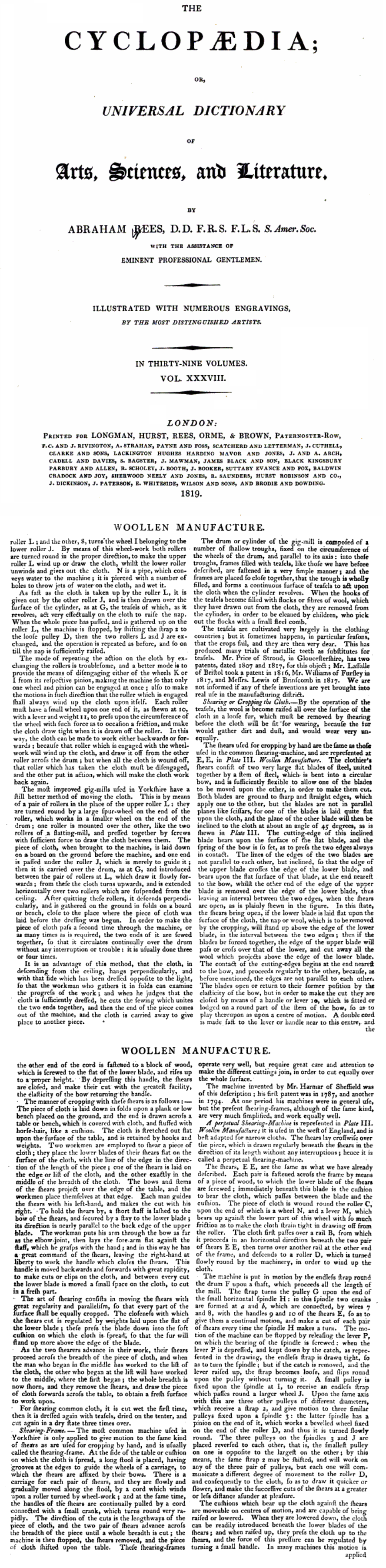
WOOLLEN MANUFACTURE.
The teasels are cultivated very largely in the clothing countries; but it sometimes happens, in particular seasons, that the crops fail, and they are then very dear. This has produced many trials of metallic teeth as substitutes for teasels. Mr. Price of Stroud, in Gloucestershire, has two patents, dated 1807 and 1817, for this object; Mr. Lassalle of Bristol took a patent in 1816, Mr. Williams of Fursley in 1817, and Messrs. Lewis of Brinscomb in 1817. We are not informed if the motions in such direction that the roller which is engaged real use in the any of these inventions are yet brought into shall always wind up the cloth upon itself. Each roller must have a small wheel upon one end of it, as shewn at 10, with a lever and weight 11, to press upon the circumference of the wheel with such force as to occasion a friction, and make the cloth draw tight when it is drawn off the roller. In this way, the cloth can be made to work either backwards or for- wards; because that roller which is engaged with the wheel- work will wind up the cloth, and draw it off from the other roller across the drum ; but when all the cloth is wound off, that roller which has taken the cloth must be disengaged, and the other put in action, which will make the cloth work back again.
The most improved gig-mills used in Yorkshire have a still better method of moving the cloth. This is by means of a pair of rollers in the place of the upper roller L: they are turned round by a large spur-wheel on the end of the roller, which works in a smaller wheel on the end of the drum; one roller is mounted over the other, like the two rollers of a flatting-mill, and pressed together by screws with sufficient force to draw the cloth between them. The piece of cloth, when brought to the machine, is laid down a board on the ground before the machine, and one end is passed under the roller J, which is merely to guide it; then it is carried over the drum, as at G, and introduced between the pair of rollers at L, which draw it slowly for- wards; from these the cloth turns upwards, and is extended horizontally over two rollers which are suspended from the ceiling. After quitting these rollers, it descends perpendicularly, and is gathered on the ground in folds on a board or bench, close to the place where the piece of cloth was laid before the dressing was begun. In order to make the piece of cloth pass a second time through the machine, or as many times as is required, the two ends of it are sewed together, so that it circulates continually over the drum without any interruption or trouble: it is usually done three or four times.
It is an advantage of this method, that the cloth, in descending from the ceiling, hangs perpendicularly, and with that fide which has been dressed opposite to the light, so that the workman who gathers it in folds can examine the progress of the work; and when he judges that the cloth is sufficiently dressed, he cuts the sewing which unites the two ends together, and then the end of the piece comes out of the machine, and the cloth is carried away to give place to another piece.
PublicationImage or PrintDateSourceGoogle BooksLink