
1842-07-23 Shanks Grass-Cutting and Rolling Machine
Mechanics' Magazine,
MUSEUM, REGISTER, JOURNAL, AND GAZETTE.
No. 989.]
SATURDAY, JULY 23, 1842.
[Price 6d. Double.
Edited, Printed and Published by J. C. Robertson, No. 166, Fleet-street.
SHANKS' GRASS-CUTTING AND ROLLING MACHINE.
SHANKS'S GRASS-CUTTING AND ROLLING MACHINE. (Registered pursuant to Act of Parliament.)
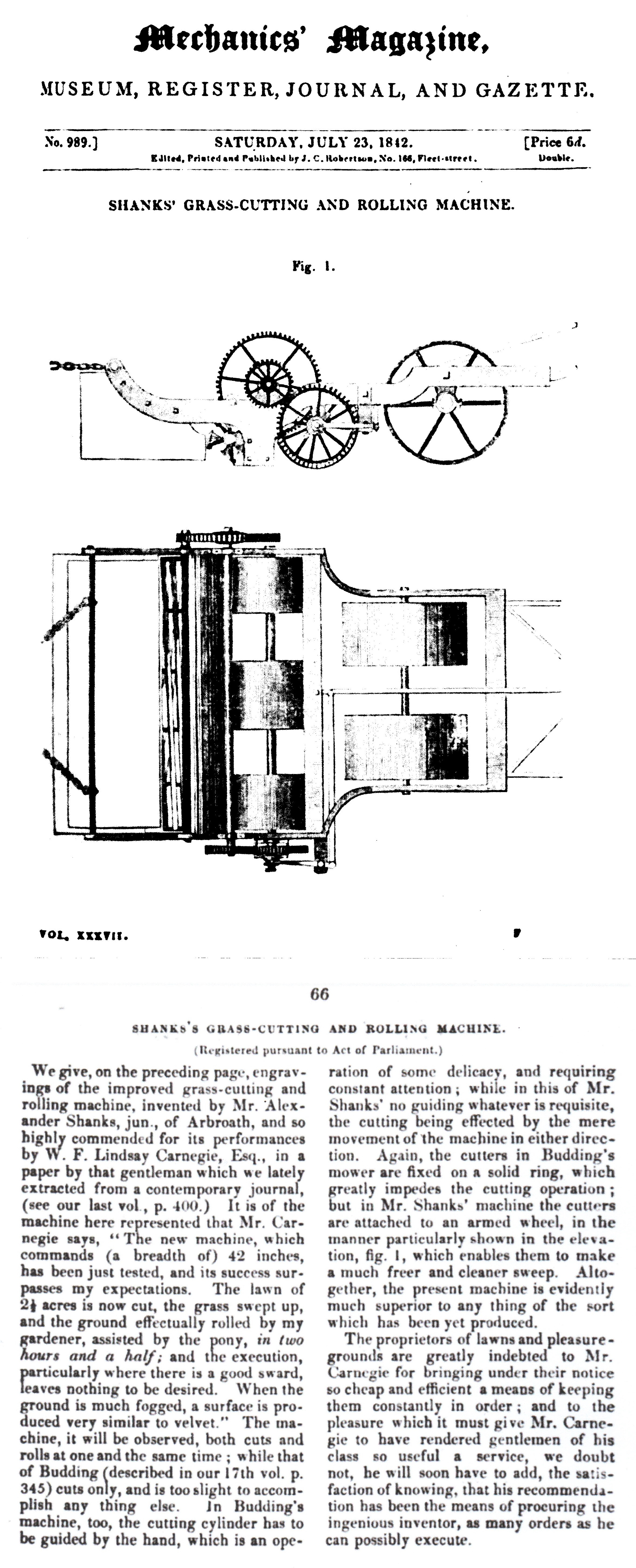
We give, on the preceding page, engravings of the improved grass-cutting and rolling machine, invented by Mr. Alexander Shanks, jun., of Arbroath, and so highly commended for its performances by W. F. Lindsay Carnegie, Esq., in a paper by that gentleman which we lately extracted from a contemporary journal, (see our last vol., p. 400.) It is of the machine here represented that Mr. Carnegie says, "The new machine, which commands (a breadth of) 42 inches, has been just tested, and its success surpasses my expectations. The lawn of 2 acres is now cut, the grass swept up, and the ground effectually rolled by my gardener, assisted by the pony, in two hours and a half; and the execution, particularly where there is a good sward, leaves nothing to be desired. When the ground is much fogged, a surface is produced very similar to velvet." The machine, it will be observed, both cuts and rolls at one and the same time; while that of Budding (described in our 17th vol. p. 345) cuts only, and is too slight to accomplish any thing else. In Budding's machine, too, the cutting cylinder has to be guided by the hand, which is an operation of some delicacy, and requiring constant attention; while in this of Mr. Shanks' no guiding whatever is requisite, the cutting being effected by the mere movement of the machine in either direction. Again, the cutters in Budding's mower are fixed on a solid ring, which greatly impedes the cutting operation; but in Mr. Shanks' machine the cutters are attached to an armed wheel, in the manner particularly shown in the elevation, fig. 1, which enables them to make a much freer and cleaner sweep. Altogether, the present machine is evidently much superior to any thing of the sort which has been yet produced.
The proprietors of lawns and pleasure-grounds are greatly indebted to Mr. Carnegie for bringing under their notice so cheap and efficient a means of keeping them constantly in order; and to the pleasure which it must give Mr. Carnegie to have rendered gentlemen of his class so useful a service, we doubt not, he will soon have to add, the satisfaction of knowing, that his recommendation has been the means of procuring the ingenious inventor, as many orders as he can possibly execute.