
1833 Arcana of Science and Art
ARCANA
OF
SCIENCE AND ART:
OR, AN
ANNUAL REGISTER
OF
USEFUL INVENTIONS AND IMPROVEMENTS, DISCOVERIES AND NEW FACTS,
IN
MECHANICS, CHEMISTRY, NATURAL HISTORY, AND SOCIAL ECONOMY;
ABRIDGED
FROM THE TRANSACTIONS OF PUBLIC SOCIETIES, AND FROM THE SCIENTIFIC JOURNALS, BRITISH AND FOREIGN,
OF THE PAST YEAR.
WITH FORTY-THREE ENGRAVINGS.
This work may be considered as an Encyclopædia, to which the most eminent of their time are constantly contributing."
New Monthly Magazine. - Notice of Arcana of Science, 1832,
SIXTH YEAR.
LONDON:
PRINTED BY AND FOR JOHN LIMBIRD, 143, STRAND.
MDCCCXXXIII.
GARDENING.
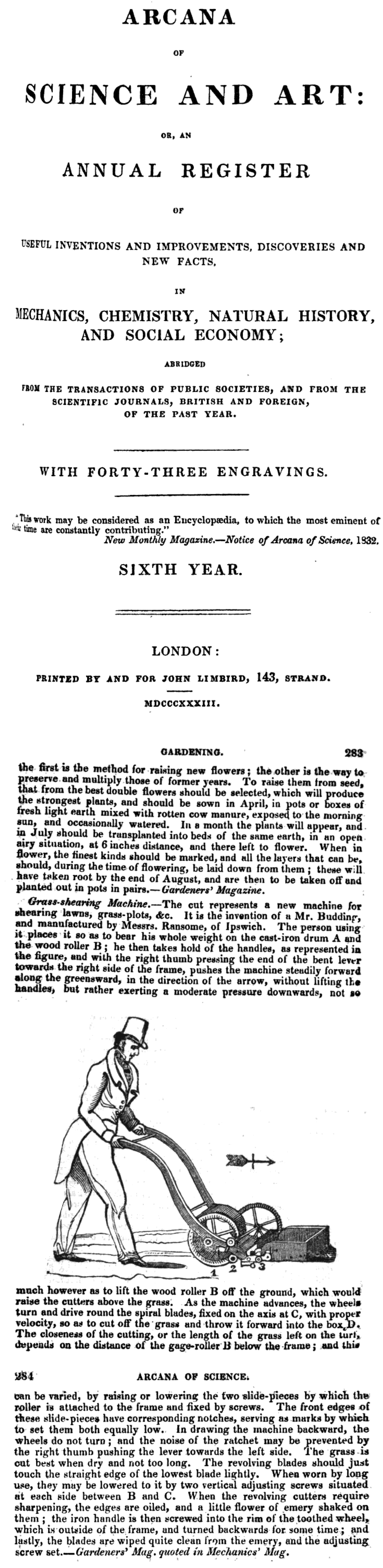
Grass-shearing Machine.-The cut represents a new machine for shearing lawns, grass-plots, &c. It is the invention of a Mr. Budding, and manufactured by Messrs. Ransome, of Ipswich. The person using it places it so as to bear his whole weight on the cast-iron drum A and the wood roller B; he then takes hold of the handles, as represented in the figure, and with the right thumb pressing the end of the bent lever towards the right side of the frame, pushes the machine steadily forward along the greensward, in the direction of the arrow, without lifting the handles, but rather exerting a moderate pressure downwards, not so much however as to lift the wood roller B off the ground, which would raise the cutters above the grass. As the machine advances, the wheels turn and drive round the spiral blades, fixed on the axis at C, with proper velocity, so as to cut off the grass and throw it forward into the box D. The closeness of the cutting, or the length of the grass left on the turf, depends on the distance of the gage-roller B below the frame; and this can be varied, by raising or lowering the two slide-pieces by which the roller is attached to the frame and fixed by screws. The front edges of these slide-pieces have corresponding notches, serving as marks by which to set them both equally low. In drawing the machine backward, the wheels do not turn; and the noise of the ratchet may be prevented by the right thumb pushing the lever towards the left side. The grass is cut best when dry and not too long. The revolving blades should just touch the straight edge of the lowest blade lightly. When worn by long use, they may be lowered to it by two vertical adjusting screws situated at each side between B and C. When the revolving cutters require sharpening, the edges are oiled, and a little flower of emery shaked on them; the iron handle is then screwed into the rim of the toothed wheel, which is outside of the frame, and turned backwards for some time; and lastly, the blades are wiped quite clean from the emery, and the adjusting screw set. Gardeners' Mag. quoted in Mechanics' Mag.