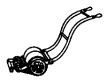
1862-05-23 Mechanics Magazine - Ferrabee Bat Feeding Machine

Page 346 THE MECHANICS' MAGAZINE.
FERRABEE'S PATENT "BAT"-FEEDING MACHINE FOR CARDING ENGINES. (MAY 23, 1862,
THE machine represented by the above engraving is the invention of Mr. James Ferrabee, of Phoenix Iron Works, Stroud, and is shown at work by Messrs. Platt Brothers, of Oldham, in the Western Annex of the International Exhibition, where it attracts considerable attention, not only from those immediately interested in woollen manufactures, but also from the general public.
Description and reference to the figure:-The working parts of the machine are sustained in an iron frame. 4 is a strap to give motion through the wheels H to the roller B which supports and moves the endless travelling lattice C. DD are levers of a vibrating frame, the long levers having their fulcrums on the spindle of the roller B, and the short levers being jointed to the carriages of the tin rollers EE; these carriages are moved backwards and forwards on the top of the rail of the frame of the machine by means of an endless belt and stud, taking with them the tin rollers EE, and the vibrating frame DD; F is another endless travelling lattice driven by the cone pulleys G and the chain wheels connected there- with. The tin rollers EE traverse the lattice Fto and fro.
The machine being put into motion, wool or other material would be delivered on to the lattice C. by which it would be carried forward and deposited between the rollers EE; as these rollers traversed to and fro, the wool would be laid in
layers one over the other on the lattice F, and the thickness of those layers would depend on the speed at which the lattice Fmoved, which can be regulated by shifting the strap on the cone pulleys G; the wool thus laid would be passed from the machine by the motion of the lattice F. The invention admits of various modifications to adapt it to the making of unwoven felt-cloths, wadding, and for other purposes, but this notice will be confined to its application to the process of carding wool. In that process wool passes through a series of three machines called " carding engines," distinguished as, first, the "scribbler," second, the "intermediate," and third the "finisher." The three separate cardings performed by these machines, are intended to effect a thorough mixing of the wool, and a uniform distribution of its fibres, after which it is divided and rubbed or "condensed" into round felt "slivers" or bands, to be wound on to bobbins ready for the creel of the mule. Wool, in weighed quantities, is fed to the "scribbler" by hand, and leaves that machine in the form of a thin fleece. Here the "feeding machine" takes it up, and the fleece is, by means of the lattice C and the rolls E E, carried for. ward and laid in layers one on the other on the lattice F, so as to form what is termed a "bat," the thickness of which may be regulated at plea- sure, as above mentioned. The "bat" thus formed is conducted by the "feeding machine" to the "intermediate" or second carding engine, and after undergoing a second carding the wool again
appears in the form of a thin fleece, which is taken up by another "feeding machine" and by it formed into a "bat" in the same way as before described, and then conducted to the "finisher" or third carding engine.
Connected to the "finisher" is an apparatus called a "condensor," which divides the fleece as it leaves the carding rollers, and by means of vibrating sheets of leather rubs it into round felt bands ready for winding upon bobbins. Feeding machines may be constructed to form and con- duct the "bat" in a direct line from one carding engine to another, or to form what is called a "cross bat," to be fed to a carding engine placed at a right angle to that one from which the fleece would be taken. The illustration shows a "cross bat" feeding machine in which the lattice Cand rollers E E lay the fleece transversely in the lattice F. A machine to both receive and feed in a direct line would have the vibrating frame D, the lattice C, and the rollers E E, to act in the same direction as the lattice F moves. The introduction of the "bat feeding machine" enables manufacturers to use "condensors" on coarse wools, which has not been successfully accomplished by any other means, and its capability to properly mix wool and dis- tribute its fibres is said to be a great improvement on the methods hitherto practised.