
Another Original Early Lawnmower Leaflet
The original of this extremely rare leaflet is preserved at The North Yorkshire County Record Office.
This confirms that the lawnmower was available in two sizes of cutting width - 16 and 22in - and that orders could be received in London by Messrs Lewis & Davies of No. 10 Basinghall Street. These were the same Lewis and Davies who had their factories in Stroud so it would have been convenient for Ferrabee to supply the lawnmower through their London offices.
We can also infer that the lawnmower was also available through other agents by this time because in this leaflet "Orders received by J. Ferrabee, and by" is printed to leave a blank space for (in this example) the details of Lewis and Davies to be written in by hand. This would have saved the considerable expense of printing a separate leaflet with each agent's details.
This leaflet contains more detail than the other early leaflet also printed by W. Fowler of Cirencester, which is not far from Stroud. The additional detail may mean that this particular leaflet was produced slightly later. However, both must date from between 1830 and mid-1833: Lewis and Davies were mentioned as suppliers in the Loudon article of 1831 and the printer was declared bankrupt on 28 June 1833.
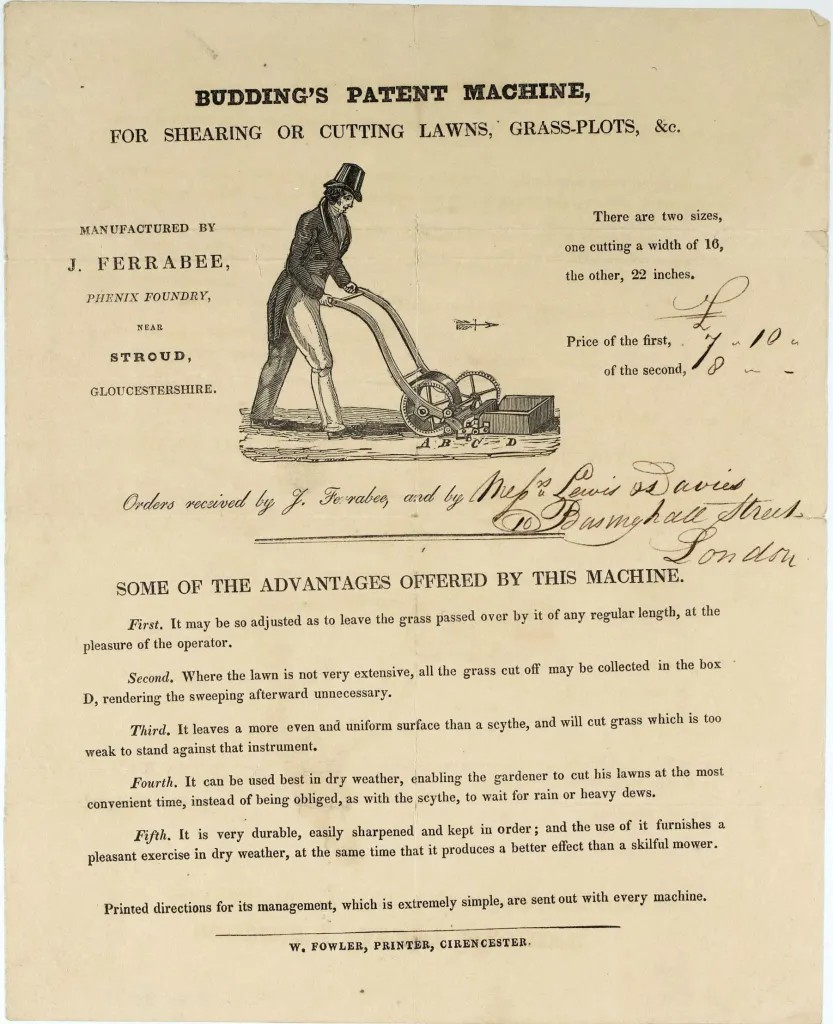
BUDDING'S PATENT MACHINE,
FOR SHEARING OR CUTTING LAWNS, GRASS-PLOTS, &c.
MANUFACTURED BY
J. FERRABEE,
PHENIX FOUNDRY,
NEAR
STROUD,
GLOUCESTERSHIRE.
There are two sizes,
one cutting a width of 16,
the other, 22 inches.
Price of the first, £7 10 of the second £8 0 0
Orders received by J. Ferabee, and by Messres Lewis and Davies, 10 Basinghall Street, London
SOME OF THE ADVANTAGES OFFERED BY THIS MACHINE.
First. It may be so adjusted as to leave the grass passed over by it of any regular length, at the pleasure of the operator.
Second. Where the lawn is not very extensive, all the grass cut off may be collected in the box D, rendering the sweeping afterward unnecessary.
Third. It leaves a more even and uniform surface than a scythe, and will cut grass which is too weak to stand against that instrument.
Fourth. It can be used best in dry weather, enabling the gardener to cut his lawns at the most convenient time, instead of being obliged, as with the scythe, to wait for rain or heavy dews.
Fifth. It is very durable, easily sharpened and kept in order; and the use of it furnishes a pleasant exercise in dry weather, at the same time that it produces a better effect than a skilful mower.
Printed directions for its management, which is extremely simple, are sent out with every machine.
W. FOWLER, PRINTER, CIRENCESTER.
PublicationImage or PrintDateSourceNorth Yorkshire ArchivesLink