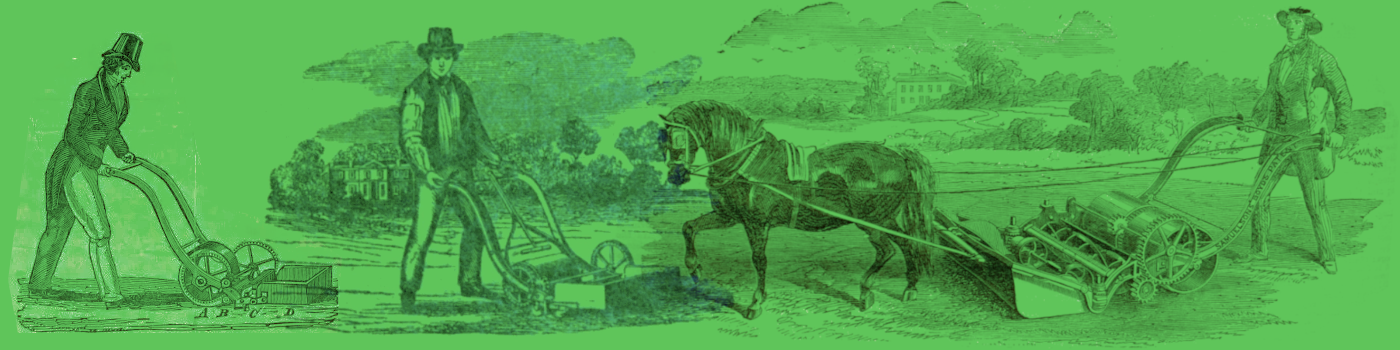
The Origins of the Lawnmower
1770
Of all the inventions associated with that period we call the “industrial revolution”, the lawn mower is for many a mere footnote.
The basic details of its invention are generally well known among enthusiasts and garden historians. It was invented by Edwin Beard Budding who was born and lived in the area around Stroud in Gloucestershire, England during the first half of the 19th century.
Various books and online sources have retold this basic story. But nobody has ever made a concerted effort to dig into the finer details of the circumstances of why the lawnmower was invented at that time and at that place.
Until now.
For the first time, this new section of our website aims to bring together in one place details and information about the industries and personalities that led to the invention of the lawnmower in 1830. As we shall see, Budding drew inspiration from the major industries in the area at that time. This is no surprise as many inventions are based on ideas and technologies that already exist. What makes an “invention” is the ability to apply these concepts in new ways and the foresight to see potential in the use of the result.
The invention of the lawnmower, it could be argued, led to fundamental changes in society. For the first time it was possible to manage large areas of grassland economically and conveniently. This meant that people could create and manage lawns for leisure at home, in civic parks for improved public health and recreation, and at sporting venues for the growing number of organised sports.
This first section in our project covers the period up to and including the invention of the lawnmower. In future instalments we will be covering the years that followed as new manufacturers and designs emerged. In doing so we have uncovered some interesting and hopefully useful information that helps tell the story with new perspectives.
Stroud and the surrounding area played a significant role in the industrial revolution.
Historically, sheep farming and wool production were significant industries that had been growing since medieval times.
The natural landscape, which included several rivers, allowed water wheels to power a wide range of machinery. This meant that many labour-intensive processes could be mechanised as inventors devised new machinery.
The development of the canals from the 18th century onwards supplemented the rivers to create a network connecting major local towns and villages with the wider world. The Thames and Severn Canal and the Stroudwater Navigation, for example, opened in the late 18th Century. Materials could be imported into the area and finished products taken away more easily. Following the invention of the steam engine, for example, coal was brought from the nearby Forest of Dean to power these powerful new machines.
The textile industry continued to grow as inventors and entrepreneurs devised new and more efficient ways to process the wool and turn it into cloth. By the middle of the 18th century the landscape was dotted with mills and the various factories and workshops needed to support them: foundries, brass works, forges and more.
The result, although they did not know at the time, was that Stroud and the surrounding area contained all of the skills, expertise, resources, and facilities to create the world's first lawn mower.
1788
John Ferrabee was born c1788 near Stroud, Gloucestershire. His ancestors were local broadweavers, blacksmiths, and millwrights. Over the following decades, initially working with his father, Edward Ferrabee (sometimes recorded as Veriby), John was to grow the family's cottage industry to create a major business at Thrupp Mill and the Phoenix Foundry & Ironworks.
| SIGNIFICANT EVENTS IN THE LIFE OF JOHN FERRABEE | |
| Year | Event |
| 1788 | Birth of John Ferrabee. |
| 1792 | Father Edward rents property at Thrupp. |
| 1816 | Birth of son William Ferrabee. |
| 1818 | Birth of son James Ferrabee. |
| 1828 | Takes lease on Thrupp Mill. |
| 1828+ | Converts Thrupp Mill from cloth production to iron foundry. |
| 1829 | Death of Edward Ferrabee, aged 82. |
| 1830 | Partnership with Edwin Beard Budding covering development of lawnmower. |
| 1830 | Register patent for improvements in machinery for preparing the face of woollen and other cloths. |
| 1830+ | Begins exclusive production of Budding's Patent Lawnmower. |
| 1831 | Writes will. |
| 1833 | Dissolves transportation business with John George and John Price. |
| 1834 | Gloucestershire electoral register records John Ferrabee as freehold resident of Thrupp Mill. |
| 1843 | Buys Thrupp Mill for £4000. |
| 1843 | Amends will. |
| 1852 | Business taken over by sons William and James. |
| 1853 | Death of John Ferrabee. |
1792
The family of Ferrabee, or Veriby in the vernacular spellings of the day, were from at least the 17th century, broadweavers from the Owlpen and Uley area near Stroud and Dursley in Gloucestershire, according research completed in the early 1950s by H.B. Randall, a relative by marriage to a descendant of John Ferrabee of Thrupp. Several members of the family were probably blacksmiths and millwrights.
A bridge over one of the old mill leats of the river Ewelme at Uley, near the site of the Uley Ironworks. The stone ashlar blocks may have come from a demolished mill or other industrial building.
An old indenture paper (seen by H. A. Randall) included a reference to “Foundry & Workshop” at Thrupp. Although there was no mention in this of Veriby or Ferrabee, Randall writes that “Ferrabees had been at Thrupp for 15-20 years previously [prior to 1792].”
At this time there were two mills at Thrupp and many cottage weaving industries. Property was generally owned by the landed gentry.
The lower photograph shown here is a close up of the upper photograph of Thrupp which was taken around 1900.
A: site of Thrupp Mill, demolished at this time, with lifting gantry installed on the site by George Waller.
B: original Phoenix Foundry & Ironworks buildings. This is mostly now a car park.
C: The Meadows, now the site of The Stroud Brewery.
D: there were at least two main Mill buildings, Upper & Lower at Thrupp. The building still standing at time of the photograph survived into the 20th century.
E: site of surviving (in 2025) stone bridge over remaining course of River Frome.
1793
The first documentary evidence of a Ferrabee at Thrupp, is of Edward Veriby in an indenture concerning cottages part-rented in October 1793. His son John was Edwin Beard Budding's patent partner.
Marked by the green spot on this 1880s map, this elegant Cotswold stone voussoir bridge that carried a lane directly in front of Thrupp Mill is all that survives from Edwin Beard Budding and John Ferrabee's time.
1796
Edwin Beard Budding, the inventor and patentee of the first lawnmower, was born on 25 August 1796 in the Parish of Eastington, Gloucestershire. His mother Mary Beard was not married to his father, Charles Budding.
| SIGNIFICANT EVENTS IN THE LIFE OF EDWIN BEARD BUDDING | |
| Year | Event |
| 1796 | Birth of Edwin Beard Budding. |
| 1796 | Baptism of Edwin Beard Budding. |
| 1821 | Marriage to Elizabeth Chew. |
| 1820s | Design and Manufactures Pistol. |
| 1820s | Working for John Ferrabee as mechanic (or mechanician) at Thrupp Mill. |
| 1830 | Enters agreement with John Ferrabee covering investment in lawnmower design. |
| 1830 | Registers patent for lawnmower. |
| 1830 | Registers patent for improved couplings for bands or straps. |
| 1842 | Registers patent for adjustable spanner. |
| 1846 | Death of Edwin Beard Budding. |
| 1846 | Buried in St Mark's Churchyard, Woodmancote. |
Edwin Beard Budding was baptised at St. Michael and All Angels Church, Eastington, Gloucestershire on 10 November 1796. It is likely that he was baptised in the church's 12th century font, pictured here.
| Patents Registered by Edwin Beard Budding | ||
| Number | Date | Description |
| 5990 | 31/08/1830 | Combination and application of machinery for shearing lawns and grass-plats (in place of scythes.) |
| 8860 | 15/10/1840 | Machinery for cutting vegetable and other substances. |
| 9788 | 15/06/1843 | Covering the cylinders of carding and scribbling engines; condensing the rovings delivered from such engines; apparatus for grinding the points of the cards, which apparatus may also be employed for grinding other articles. |
Edwin Beard Budding is known to have registered a number of patents, either on his own or in partnership with other local businessmen and engineers. Additional references will be added to this list in due course.
1815
Newly-woven woollen cloth often has an uneven surface with tufts and bobbles caused by the natural fluctuations in the thickness of the threads and the weaving process. To create an even and smooth surface the new fabric was teased to raise the nap (the fluffy surface of the cloth) and then sheared by hand but this was a time-consuming and laborious process that was typically done by a skilled shearsman using clippers or shears.
Various people tried to devise a way to mechanise the shearing process but none was very successful. In 1815, however, an engineer called John Lewis who was working at Brimscombe Mill came up with a new type of machine. Known as the cross cutter, this was designed to finish the cloth by trimming and smoothing its surface. Lewis registered the design under Patent No. 3945 in July 1815 and it was introduced in 1818. By 1829 it is said he had sold several thousand machines.
Its design and operation was ingenious...
The machine was roughly the size of a double bed and it was built around a cast iron frame which in addition to being strong would have provided a rigid and stable base for the work in hand. Attached to this are various wooden, leather, and metal components to secure, tension, and trim the cloth.
The section of cloth to be trimmed is held in tension cross-wise using hooks along its edges (known as the selvedge or list). The cloth is held in tension length-wise by the rollers mounted under the frame which carry the length of cloth. A frame comprising wood and leather provided a secure and firm bed underneath the cloth being trimmed.
The part of the machine that concerns the history of the lawnmower is its cutting mechanism. A spiral cutter extends across the width of the machine. A fixed blade - known as the ledger blade - is mounted beneath it across the whole length such that the two are barely touching. The drive mechanism ensures the spiral rotates quickly to provide what it effectively a continuous shearing or scissoring action in conjunction with the fixed blade. At the same time the entire cutter mechanism is drawn mechanically across the surface of the nap (cloth), with the speed of rotation and travel held in synchronisation. In this way the cutter trims the cloth evenly and consistently as it moves across the surface. Once the section (known as a "board") has been trimmed, the cloth is unhooked and the rollers under frame turned so that a new section is now on the bed. The cloth is then re-hooked and tensioned in both directions before the mechanism is passed over it.
Various levers, pulleys, and wheels allowed fine adjustments to the tension of the cloth and the speed at which the machine could operate. The entire machine was powered by a belt connected to an overhead rotating shaft driven by the mill's waterwheel or, later, steam engine.
The invention of the cross cutter meant that any length of cloth could be trimmed quickly to produce a consistently smooth surface. Contemporary reports suggest one machine could trim a length of 21 yards (approximately 20 metres) in about two hours. Two machines could be worked by two boys supervised by a man. Much more cloth could be processed each day, and with far fewer people who had lesser skills, than with the previous manual methods. The machine was so successful that is quickly replaced the shearsmen in many mills in the area and further afield. Modern machines work on broadly the same principles.
Today, we can recognise that the cross cutter has many similarities with the original lawnmower.
Read more about the Cross Cutter at the Stroud Textile Trust.
From this close-up view of the Lewis cross cutter we can see the rotating spiral cutter and the fixed ledger blade underneath. It was this arrangement that we assume inspired the invention of the lawnmower a decade or so later.
Another surviving Lewis patent cross cutter can be seen at the Dunkirk Mill Museum in Gloucestershire
The Upper and Lower Mills at Brimscombe were run together under a single owner or tenant. In 1539 John Bigg leased two fulling mills at Brimscombe and in 1594 Ursula Bigge of Stroud owned the mills and Bigges Place. When Roger Fowler died in 1626 his will mentioned the house called Bigges Place, together with two fulling mills, a gig mill and corn mill. In 1648 Henry Fowler of Minchinhampton conveyed 'all those ffullinge mille gig mille and grist mille and barn', all of which were occupied by Henry Mayo, to William Webb of Stroud, clothier. In 1705 the property, occupied by Thomas Pointin, was conveyed to Brice Seed. In 1733 Brice Seed and Walter Davis conveyed 'all that fulling mill consisting of three stocks and a gig mill ... and the new erected building standing near to the mill pond designed for a grist mill but now converted into a messuage or tenement', to John Dallaway who occupied the premises at the time.
In 1760, the site comprised fulling, gig mills and 'the knapping mill house', a scouring dyehouse and blue dyehouse. In 1790 William Dallaway conveyed Bigges Place, the range of buildings lately erected by William and James Dallaway, the fulling and gig mills, the knapping mill, the scarlet, blue and scour- ing dyehouses, the shear shops and buildings called the wood house, warehouse and coal ash house to Joseph Lewis, miller. In 1838 Joseph Lewis had one power loom and thirty-one handlooms employed and twenty-nine unemployed handlooms at the mills. After Joseph Lewis's death the mills were worked by Archer Blackwell and John Remington, later by William, John and George Lewis, and by 1840 by William Lewis alone. Lower Mill was rebuilt in 1843 and in that year Lewis went bankrupt and the mills were offered for sale. The property was bought by John Ferrabee, who also bought all the machinery in the mills except the stock, gigs and gearing. A detailed inventory of the machinery was made and this is the earliest date for which there is any information about the uses to which each of the two mills were put. The 'Large Mill', presumably Upper Mill, was devoted to wool and yarn preparation and dyeing, while weaving was located at Lower Mill. In 1845 the mills were again for sale. Two steam engines are mentioned in the particulars and John Webb was said to be occupying the mills, while Christopher Smith occupied the dyehouses. The property was bought by Samuel Stephens Marling who leased it in the same year to Thomas William and Thomas Coke White of Monks Mill, Alderley. Upper Mill had an iron waterwheel and a 40hp steam engine. There were eight pairs of iron fulling stocks and four broad gig mills. Lower Mill contained three waterwheels, a 20hp steam engine, and six pairs of iron stocks, six gig mills. There was no mention of looms.
In 1858 Samuel Stephens Marling leased Brimscombe Upper and Lower Mills to P.C. Evans and John William Bishop, clothiers. P.C. Evans was the son of Aaron Evans who worked one of the mills in the Toadsmoor Valley. The schedule which follows on the deed shows that the uses of the various floors in the Upper Mill probably remained much the same. The fulling stocks had been removed and two fullers by Ferrabee and two by Buck had been installed in their place. One waterwheel and the stocks had been removed from the Lower Mill. An indenture attached to the deed records alterations made by Marling at the cost of £3,865. He erected a new loom shed and a building around 64ft by 27ft which was to be a new willy and oiling house and mechanic's shop. The open air stove was converted into a closed warehouse 'by building up the former chequered brick work walls'. He agreed to erect a building at the Lower Mill where P.C. Evans could install his dyeing machinery. In 1889, P.C. Evans & Sons had 124 looms and 6,400 spindles at the two mills. More details are given in Worrall's Directory two years later: there were 5,670 mule and 818 doubling spindles for woollen yarn and 1,540 spinning and 770 doubling spindles for worsted yarn. The looms had been increased to 144. In 1920 the firm amalgamated with Marling & Co. Ltd at Stanley and Ebley. Little work was done at Brimscombe after that and the mills were eventually sold. The two mills are illustrated in Industrial Gloucestershire. The Upper Mill consisted of a large, wide range with a tall chimney adjacent and a number of smaller buildings. The main mill building has been demolished. The former dyehouses, adjoining the pond and what was probably the counting house, remain. Lower Mill consisted of one main range of three distinct sections. This mill was burnt down between 1918 and 1930 when it was used as a teazle store for P.C. Evans & Sons. After the Second World War Upper Mill was Lewis & Hole's iron foundry, Lower Mill being an electro-plating works. In 1967 Perolin Chemicals acquired the site. Little remains of the original textile factory buildings. Bigges Place was demolished for road widening.
Sources:
A history taken from "Wool & Water": The Gloucestershire Woollen Industry And and its Mills, by Jennifer Tann; P.H. Fisher, Notes and Recollections of Stroud, p.8; PRO E315/394; D873b; D873 E12; D181/III/T9; PP 1840, XXIV, pp. 396–7; D1159; G.R.O. D1241, Sale Particulars; Kelly's Textile Directory 1889)
Read more about Brimcombe Mill.
Belvedere Mill is typical of the local stone ashlar water mills that were dotted around the area in the early 19th century. The mill still exists and is located approximately two miles from the site of Thrupp Mill..
1816
John Ferrabee was described as “Millwright of the Thrupp” when his eldest son William was born.
Edward Beard Budding, often styled “the jobbing Engineer”, is known to have worked closely with Edward Veriby at Thrupp on textile related machinery. He also worked at The Earl of Ducie’s Ironworks at Uley with Richard Clyburn, who plagiarised Budding's Registered design for an adjustable spanner, improved it, and patented it.
Uley Ironworks was at the Former Mill of Edward Sheppard on the River Ewelme, in the Valley below Uley and was repurposed for the agricultural works. After The Earl of Ducie closed the ironworks it became a sawmill, marked on the 1880s Ordnance Survey Maps as "Shepherds Mill."
Another Engineer resident at Uley Ironworks, who collaborated with John Ferrabee & Edward Beard Budding, was George Lister from Yorkshire. He was the father of R.A. Lister, the founder of Lister’s of Dursley Engineering Co.
This 1816 map shows the valley of the River Frome, with Thrupp Mill at that time being known as Wathen's Mill. Thrupp and the adjoining mills had many name changes based on ownership and residency over the previous centuries prior to Budding and the Ferrabees.
1817
Gigging (also known as raising or napping) is the process of raising the surface of cloth to create the nap (in other words to make it fluffier). The resulting nap can be uneven so the cloth has to be trimmed to produce a consistent and smooth surface.
In pre-industrial times, gigging and shearing were done by hand but it was a slow and laborious process. The invention of mechanical cross cutters and gigging mills meant that these two vital processes could be done more quickly and with fewer people so that more cloth could be treated each day.
This patent, No. 4189 and dated 19 December 1817, is for wire gig-mills for dressing woollen and other cloths. It was registered by John and William Lewis with William Davis. John Lewis had registered a patent for a mechanical cross cutter in 1815, just two years before, and this meant that he held patents in two significant mechanical innovations for the cloth making industry.
The wire gigging mill basic design incorporates wire teasels (similar to small wire brushes) mounted on frames. The cloth was passed over the frame and the teasels gently raised the nap. The use of wire was a significant step forward: before, the nap was raised using natural teasel heads either by hand or, later, mounted on basic machines. Wire is more durable so teasels lasted longer which meant they did not need to be replaced as often. Managing the length of the individual filaments during manufacture of the teasels and adjusting the gigging mill would have made it possible to control the gigging process more accurately.
Information about the Ferrabee family and their blacksmithing, loom construction, and millwright work in the early 19th century is rather scarce. The Lewis and Davies families were far more influential and prominent than the Ferrabees (or Budding) during this period. They took out many patents on textile machinery improvements, including the cross cutter and the wire gig mill. However, some of these were made in conjunction with John Ferrabee.
The close working of these local entrepreneurs led in the 1830s to Lewis and Davis acting as John Ferrabee's agents in London for receiving order for Budding's patent lawnmower.
1818
John Ferrabee had several children. The most notable was probably James, who was baptised 13 December 1818 at St. Lawrence's Church, Stroud.
James was to become, from 1853 with his brother Henry and solely from late 1855, the director of The Phoenix Iron Works.
1821
Edwin Beard Budding married Elizabeth Chew at St. Swithun's Church, Hempstead, near Gloucester on 13 May 1821.
The Stroudwater Canal from Framilode Lock at the River Severn to Wallbridge Wharf ("Stroudwater") was completed in 1779. It replaced an earlier and less well-known navigation called the Kemmett Canal, which used sections of the River Frome.
The Stroudwater Canal passes through the parish of Eastington where Edwin Beard Budding was christened in 1796.
Mills and industry were already established in the area during Budding's childhood. The canals were the motorways of their day and helped to accelerate the growth in the textile and other industries.
The Thames and Severn Canal was completed from the Thames near Lechlade to Stroudwater Junction at Wallbridge in 1789.
The canal ran down the Frome Valley, next to the River and Thrupp Mill where John Ferrabee started to lease the complete site in 1828 and where Edwin Budding had been making Pepperbox Pistols.
By the time John Ferrabee's father, Edward Ferrabee (or Veriby) was at Thrupp by 1792, the canal was creating a link between the Severn and the Thames.
John Ferrabee is known to have improved the efficiency of the by then "old" beam engine at Thames Head on the Thames & Severn Canal Navigation.
Bagpath Bridge over the Thames & Severn Canal is certainly an original bridge, so without doubt Edwin Budding would have crossed this many times when walking from Uley or Minchinhampton.
Later, when the railway arrived, the Ferrabees sold some land to the railway company.
1824
Bryant's map of 1824 shows Thrupp and the River Frome with buildings dotted around. The map also shows the canal linking the Thames & Severn which had been completed over 35 years previously in 1789.
This would have been in the era of influential families, notably; Wathen, Lewis, and Ferrabee. The clothier and mill owner Robert Bamford, who lent John Ferrabee money to buy the Thrupp site, resided at the time of the purchase at New House, later called Brimscombe Court.
Before Edwin Beard Budding patented the lawnmower in 1830 he had been manufacturing pistols.
Gun experts now date the pistols to the 1820s. Very few examples are known to survive.
According to Matthew Schneiderman, an expert on Budding's pistols, the design is:
- The world's oldest percussion pepperbox.
- The world's earliest percussion revolver.
- The world's earliest percussion pistol with in-line (ie horizontal) nipples. This is long before the Colt "Central Fire" model.
- The earliest copper cap pistol with an enclosed action.
- The world's earliest percussion under-hammer (under-striker) firearm.
Very little is known about Budding's gun venture, apart from the tantalizing label found with a few surviving examples which states: "Manufactured by E. Budding, Thrup Mill, near Stroud, Gloucestershire."
In this label the local Stroud printer J.P. Brisley has only used one P in Thrupp. It is unclear whether Budding was working at the Upper or Lower Mill at Thrupp at the time.
Matthew Schneiderman notes that a British Patent No. 4960 of 30 May 1824 by Birmingham gunmaker James Cook describes a very similar device. It is not know whether Budding's design was his own or based on the James Cook Patent of 1824. It is possible that if Budding had his barrels proofed in Birmingham, Cook saw the guns and patented the design himself. Without knowing the precise date of Budding's design it is impossible to know more.
Interestingly, there is a lane in Bowbridge, the next hamlet down the valley from Thrupp, called "Gun House Lane".
1826
In an indenture dated two years before he took the lease on Thrupp Mill, John Ferrabee is described as “Machine Maker” and “making looms of metal but mostly of wood.”
As well as looms, a whole range of specialist equipment was required locally for the textile industry.
1828
John Ferrabee first took on the lease of Thrupp Mill in 1828. Previously it was known as Wathen’s Mill, from the widow Elizabeth Wathen but it was certainly called “Phoenix Foundry” in 1828.
There is a cast iron name plate at Stroud Museum in the Park, dated 1828. This would most likely have been mounted near the entrance or in some other prominent position at the mill.
Thrupp Mill in 1828 would have been typical of the many mills in the area. The later Ordnance Survey Maps of 1881/2 show the lower/main Thrupp Mill building being irregular and straddling the leet of the River Frome.
This old mill building, at Chalford, 2.3 miles from Thrupp is now home to Pangolin Editions and dates from the late 16th or early 17th century. It is typical of the Cotswold stone style small, pre-industrial revolution mill buildings in the area. Thrupp Mill would probably have looked quite similar.
Local Stroud historians believe the Mill at Chalford is the one in Edward Smith's Watercolour of 1852, entitled "A Chalford Mill."
Chalford Mill has a design that would have been typical of the local mills of the early 19th century. It still stands and the watercolour from the 1850s shows how it would have looked at the time.
Thrupp Mill was situated on the River Frome, just to the south of the present A419 Stroud to Cirencester Road. Several leet’s branched off through the site to power waterwheels.
There is no known photograph of the site dating from the 19th century. Had the traveller stopped here between 1828-1863 they would have seen to the left the corner of the original Phoenix Foundry & Ironworks buildings sweeping down and Thrupp Mill to the right behind the perimeter fence and trees. The majority of the early industrial buildings were on the site of what is currently (2025) the car park of Impcross Ltd, who continue precision manufacturing on the site.
Over its lifetime the mill was known by various names: Thrupp Mill; Sewell's Mill; Huckville Mill; Wathen's Mill; Ferrabee (Phoenix) Ironworks.
There was a medieval fulling mill on this site associated with Huckville's Court. In his will of 1540, Thomas Sewell, a clothier, bequeathed to his son Thomas "my dwelling house, fullyng mylles and dyeing house" together with his "vattes and furneys with sheares and other shoppe stuffe".
In 1608 Thrupp Mill was owned by a clothier named Richard Sewell. On his death in 1635 he owned two fulling mills, one gig mill and one grain mill called Huckvales Court.
In 1708 Huckvale's Court and Sewell's Mill were conveyed to Jeremiah Davis and Richard Baker, and in 1752 let to Samuel Wathen, a member of the well-known family of clothiers, who subsequently purchased the estate.
After Samuel Wathen died his widow, Elizabeth, let "all that clothing mill" which contained five pairs of stocks, with the gig mill house, presshouse, dyehouse, stove, picking shops and rack meadow, to John Ferrabee in 1828. Ferrabee set about converting the mill for use as an iron foundry. Two waterwheels at the east end of the building and the fulling stocks were removed. Ferrabee became well known for producing waterwheels, textile machinery, agricultural implements, and Budding's lawnmowers.
The mill was demolished some time before 1901 as it is no longer marked on the Ordnance Survey maps of this year.
Historical sources note that John Ferrabee removed waterwheels and fulling stocks from Thrupp Mill at around the time he took on the lease of Thrupp Mill and its associated fields and dwellings in 1828.
Fulling stocks or fulling hammers are large wooden hammers that were used to beat newly-woven cloth. This was important as it helped to clean the cloth, remove impurities, and improve the surface ready for finishing. By the early 1800s many mills incorporated fulling stocks that were driven by water wheels or steam engines. A rotating shaft driven by the power source had a cam that pressed down on the back end of the hammer shaft, lifting the head. As the cam rotated further it released the shaft, allowing the head to fall on the cloth. Depending on the design of the shaft and the speed of its rotation each hammer could perform many beatings per minute, ensuring that fulling was quick and efficient..
The textile mills in and around Stroud faced tough competition from the mills in the north of England in the 19th century. One advantage that the Stroud clothiers had was quality. Among other products their red cloth was used by the military - an example is shown in the photographs.
Fulling stocks and other equipment used in cloth making could take up a lot of valuable space so it is no surprise that mill owners removed them if they were no longer required.
When John Ferrabee took on the lease of Thrupp Mill it contained five pairs of fulling stocks. These were soon removed as part of the conversion of the mill for use as an iron foundry.
During 2021, the cam wheels from two pairs of fulling stocks were erected next to the Stroudwater Navigation, a stone's throw from where Thrupp Mill was located. These cast iron wheels came from nearby Cam Mill and are similar to the ones that would have been used at Thrupp Mill.
The original entrance to Thrupp Mill and Ironworks was down a short lane just off the A419 Stroud to Cirencester Road.
The Thrupp Mill was to the right.
By 1881, the wall of the foundry and ironworks reached up the edge of the lane and curved to follow it. The blocks where the modern boundary fence is are modern.
In the present day, the site is occupied by engineering company Impcross.
Samuel Wathen was the previous resident at Thrupp Mill, Samuel's Widow Elizabeth "let all that clothing mill" to John Ferrabee in 1828.
Nothing above ground level remains of the Upper or lower Thrupp Mill buildings.
Photo: The River Frome passes to the right of the site of the Lower Thrupp Mill & Ironworks. The Upper Thrupp Mill was just beyond view. Photo taken 2nd of October 2024
Another view of the site of Thrupp (Lower) Mill and Phoenix Foundry, taken in 2024.
Old Thrupp Lower Mill and to the east of that where John Ferrabee first extended to create foundry buildings would have been here.
1829
Edward Ferrabee died on 17 December 1829, aged 82. He was buried at the Old Meeting Chapel, a non-conformist chapel built in c1790 and at the time located on the outskirts of Stroud. His father is described as a blacksmith and millwright.
It is not known whether Edward Ferrabee was buried inside the chapel or in the graveyard behind it.
The chapel was demolished in 1977. H. A Randall, a descendant who researched and wrote about the family, visited the chapel 25 years previously and "saw the tomb of Edward Veriby of The Thrupp."
Edward's son John Ferrabee was certainly in control of the business by this time. A short while later, in early 1830, John Ferrabee entered into partnership with Edwin Beard Budding to patent and produce the lawnmower.
The site of The Old Meeting Chapel, Chapel Street, Stroud. The original chapel was demolished in 1977 and the site used to build houses.
There is some ground behind the buildings that was the site of the graveyard. This is where Edward Ferrabee was buried in 1829.
The site of the burial ground, to the rear of what was The Old Meeting Chapel, Chapel Street, Stroud. This is located off the current Parliament Street.
Little of the original graveyard remains. As of 2025, approximately ten gravestones survive although none of them are legible.
1830
The first formal agreement between John Ferrabee and Edwin Beard Budding concerning the lawnmower is an indenture agreement dated 18 May 1830. This outlines that the two men would collaborate, with John Ferrabee providing the finance required to produce the new design.
The two men would almost certainly have known each other well at this point. They were neighbours and may also have been friends in addition to being in business together with interests at Thrupp Mill. We can assume that the lawnmower was conceived well before the patent was applied for and granted. This indenture agreement would have helped to formulate the relationship between the two men with regards to the investments and production of the new machine.
Budding subsequently applied for the patent which was granted on 31 August 1830 as No. 5990. As an addendum to the patent documents, Budding and Ferrabee agreed that:
"Mr. J. Ferrabee, of the Thrupp Mill and foundry, near Stroud, engineer, is, by agreement with the patentee, the only person that is, or will be, authorised by him to make, vend, or license, these new machines; and due exertion will be made to supply the public, from his establishment, on the most satisfactory terms."
The original copies of the indenture dated 18 May and the patent dated 31 August 1830 are both kept at the Museum in the Park, Stroud, a mere 2.5 miles from the site of Thrupp Mill.
The world's first lawnmower was produced during or very soon after 1830, designed by Budding and manufactured by Ferrabee. From early advertisements we see models were available: a 16" cutting width at £7 10s and a 22" model at £8.
None of the very earliest lawnmowers are known to exist. The machine pictured below was made by Ferrabee around 1840 but the original model would have been almost identical.
Lawnmowers based around the original Budding Patent design were produced for over a quarter of a century. None of the very first machines dating from the early 1830s are known to survive. There are, however, there two machines that probably date from the late 1830s and early 1840s that closely follow Budding's original design. In addition there are three machines that were certainly made by Ferrabee, three probably made by Ransomes after 1861, and two made by Shanks.
All machines manufactured by Ferrabee appear to have carried a serial number which, with published and/or claimed production numbers drawn from contemporary reports, allows their dates to be estimated. Machines manufactured (or believed to be made) by Ransomes carry no identifiable serial numbers and the dates given are for the introduction of the model as it is impossible to estimate the year of production.
| EXISTING EARLY BUDDING STYLE LAWNMOWERS | |||||
| Serial No | Manufacturer | Model | Cutting Width (in) | Approximate Date | Current Location |
| 1623 | John Ferrabee | Budding Patent | 19 | 1840 | Museum of Gardening, Hassocks (loaned by Ransomes Jacobsen Ltd) |
| 3157 | John Ferrabee & Sons | Budding Patent | 19 | 1849 | Science Museum, London. |
| 7508 | J. Ferrabee & Co. | Ferrabee Improved | 12 | 1858 | Museum in the Park, Stroud |
| 7638 | J. Ferrabee & Co. | Ferrabee Improved | 12 | 1858 | Private Collection |
| 8043 | Phoenix Iron Works Company | Phoenix Iron Works Company | 19 | 1863 | Museum in the Park, Stroud |
| Link | Ransomes & Sims | Ransomes Improved | 14 | 1862-66 | Wimbledon Museum of Tennis, London |
| Link | Ransomes & Sims | Ransomes Improved | 16 | 1861-66 | Milton Keynes Museum, Milton Keynes |
| Link | Ransomes & Sims | Ransomes Improved | 18 | 1861-66 | Private Collection |
| 1147 | Shanks | Shanks Patent New Mowing & Rolling Machine | 1855 | Signal Museum, Arbroath | |
| Link | Shanks | Shanks New Improved Patent | 19 | 1862 and after | Private Collection |
Note: for the purposes of this list, a "Budding Style" lawnmower is a hand machine designed for use by one or two people, with a large diameter rear roller and large intermediate gear wheel.
The Repertory of Patent Inventions and Other Discoveries and Improvements aimed to list recent patents.
This is the listing for Budding's original lawn mower patent, No. 5990, which it published a couple of months after the patent was registered in 1830.
The original patent documents are kept at Stroud Museum in the Park.
The original patent text refers to the associated diagrams which are annotated with numbers and letters to help interpret the descriptions given.
The original patent documents are kept at Stroud Museum in the Park.
Patent 5990 LXVII December 1830 - the introduction to Budding's Patent in the Repertory of Patent Inventions.
Budding clearly had a good idea of how his new invention would be used. Not only did he envisage that the lawnmower would be used in domestic settings and on parkland but also that it would help to manage sporting surfaces such as cricket grounds. There is no doubt that the mower played its part in the growth of organised sport in the Victorian era that was shortly to commence.
The text of the patent published in to the Repertory of Patent Inventions also confirms that John Ferrabee was to be the only person allowed to manufacture and sell the new invention. Agreements like this are not uncommon - investors and/or manufacturers request or demand a degree of exclusivity in return for their support. In this particular instance, we might infer that Ferrabee requested such as agreement as he was not protected as a patentee.
The brief Summary of Edwin Buddings 1830 applied for patent in the catalogue of patents entitled
"The Titles Of Patents and Inventions."
An extract from "The Subject Matter Index of Patents & Inventions", another publication that attempted to list the growing number of patents being registered during this period.
In this text, Edwin Beard Budding is incorrectly named Edward. The publication dates from some time after 1843 and lists two additional patents registered by Budding after the lawnmower:
No. 8860, 15 October 1840: covering machinery for cutting vegetables etc.
No. 9788, 15 June 1843: covering improvements to carding and scribbling engines.
The lawnmower was not the only patent registered by Budding in 1830.
In November that year he was granted a patent covering an improved method to couple machine bands or straps. The use of belts, bands, or straps was not new and they had in fact been used to help power all kinds of machinery from well before the industrial revolution. Budding's idea would seem to be more concerned with making the joins in the belts simpler and more reliable, an important consideration when failure would prevent a machine from working.
This may be relevant to the history of the lawnmower: in the documents for his Lawnmower Patent No. 5990, Budding suggests "the revolving parts may be driven by endless lines of bands instead of teeth." In this case the "teeth" are those found on the gear wheels of the first lawnmowers. Budding clearly also foresaw additional applications for flat leather and fabric belting which may have included the newly-invented lawnmower. Bands and straps incorporating the new couplings and made by Ferrabee were exhibited in London with Budding's Lawnmower in the 1830s.
Budding's reference to "endless lines of bands" is is often thought to mean chain drive (as successfully applied by Thomas Green's under Patent No. 1384 of the 6 June 1859, some 29 years later). However, pinion chains had already been invented. For example, in the London Journal for New Patents 1830, published in 1831 but prior to Budding's strap invention, there is an entry concerning a patent granted to Mr Oldham, Engineer for The Bank of Ireland, covering a design for pinion chain.
John Ferrabee was granted a patent in 1830 covering improvements to machinery used to process woollen and similar cloths.
Thrupp Mill on the River Frome consisted of two main mill buildings, the lower or main mill next to the Phoenix Foundry & Ironworks, and the upper mill.
The Upper Mill survived longer that the main lower mill and can be seen in a photograph dated c1900.
The present day view, looking to the left where the Mill stood, is now occupied by Howard Tenens although the site is still known as "Phoenix Mill".
The grey steel-clad factory building behind the trees to the right is Impcross Ltd. This is the site of George Waller's extensions to the Phoenix Works, and it is still a site of precision manufacturing excellence.
Close by there was a grassed area known as "The Meadow" where newly woven broadcloth was put out. This area is now covered by the car park of the adjoining Stroud Brewery but it is interesting to speculate that this is where Edwin Beard Budding and John Ferrabee pushed the first prototype of Budding's Mower from the factory for its first test run.
The very overgrown site of where Phoenix House once stood, right opposite where the Pheonix Foundry & Ironworks also stood.
Family member by marriage and historian of the Ferrabee family; H.B. Randall, writing in1952 asks "where did they (John Ferrabee and his family) live?" Randall states that Phoenix House, and an old cottage and then Thrupp Church were along the road, and it was possible John Ferrabee lived here. (Since it is nearest to the Foundry and bares the same name of the Foundry John created)
The 1834 county electoral register lists John Ferrabee as resident "freehold" at Thrupp Mill.
In Clive Gravetts book "Two Men Went To Mow" he identifies Phoenix House as possibly the site for the first Lawnmower trial. Logically speaking, the House and cottage are the nearest domestic dwellings to the Foundry and site of manufacture of the first lawnmower.
The apocryphal story of Edwin Budding testing the prototype lawnmower at night and causing a noise nuisance could be true as at night the quiet valley sides would certainly reverberate any noise, after the cacophony of the Fulling stocks, forges and Mills running by day.
Testing at night in secrecy can also be explained to be a prudent move as the various "clothier" entrepreneurs were constantly copying each others designs, notably in the sphere of textile machinery improvements.
Lawns before the lawnmower's invention were certainly maintained by the Scythe or large country house lawns by Sheep. O.S. maps show a small domestic area adjacent to the house on the south west side, as the north east side was very close to the bank of the modern road, which was built prior to 1824 as shown on Bryant's Map.
The English Patent No. 5990 of 1830 for Edwin Budding's lawnmower ran for 14 years.
Writing almost 70 years before, Adam Smith, one of the founders of modern economics and a leader of "The Enlightenment" made some interesting observations on the need for protection for inventors and manufacturers.
1831
This article from the Gardener's Magazine, Volume VII, 1831, appears to be one of the first printed reports about the lawn mower.
John Claudius Loudon (1782-1843) was a Scottish botanist, garden designer, and author. During the period leading up to, and after, the invention of the lawnmower he was one of the pre-eminent commentators on gardening and garden design.
Writing in The Gardeners' Magazine in 1831, he reports that Mr Curtis the Foreman at the Regent’s Park Zoological Gardens, on September 23rd informed the publication that he was entirely satisfied with the new mower and noted it was used with two men, one to draw and another to push. The machine had been used by the Zoological Gardens for four months over the first Summer of mechanised lawn care in 1831.
Loudon writes: “The machine is manufactured by J. Ferrabee, Phoenix Foundry, near Stroud, Gloucestershire, the price is from seven to ten guineas, and orders are received in London by Messrs Lewis & Davies of No. 10 Basinghall Street, London.”
No known early engravings show the draw handle.
This article notes that “Budding’s Patent Mower” drew inspiration from a machine built to shear cloth, this being Lewis’s Patent Cross Cutter, Patent No.1737 of 1815. There is a surviving example of this machine in the Museum in the Park in Stroud Museum that may have been made by John Ferrabee. It is displayed next to a Ferrabee “Improved” 12in lawnmower of c1858, serial No. 7508).
This leaflet was probably produced in 1830 or soon after and it may well be the first ever piece of lawn mower publicity.
An original copy is held in the North Yorkshire County Record Office.
The original of this extremely rare leaflet is preserved at The North Yorkshire County Record Office.
This confirms that the lawnmower was available in two sizes of cutting width - 16 and 22in - and that orders could be received in London by Messrs Lewis & Davies of No. 10 Basinghall Street. These were the same Lewis and Davies who had their factories in Stroud so it would have been convenient for Ferrabee to supply the lawnmower through their London offices.
We can also infer that the lawnmower was also available through other agents by this time because in this leaflet "Orders received by J. Ferrabee, and by" is printed to leave a blank space for (in this example) the details of Lewis and Davies to be written in by hand. This would have saved the considerable expense of printing a separate leaflet with each agent's details.
This leaflet, which may well be the World’s oldest surviving lawnmower “brochure”, was printed by W. Fowler of Cirencester which is not far from Stroud. This means that the leaflet dates from sometime between 1830 and mid-1833: Lewis and Davies were mentioned as suppliers in the Loudon article of 1831 and the printer was declared bankrupt on 28 June 1833.
Lewis and Davies, John Ferrabee's agents in London for receiving orders for Budding's Patent lawnmower, were based at 10 Basinghall Street, at the heart of commercial London and in the same street as the Weavers' Hall.
Directly behind No. 10 was the west end of St. Stephen's Church, its entrance portico was in Coleman Street. This church was destroyed by bombing in 1940.
Chain-driven machinery was not a new thing; the Romans used chain-driven pumps and in the renaissance, Georgias Agricola's book "De Re Metallacia" contains diagrams of practical machinery driven by chains used in mining.
In his original lawnmower patent of 1830, Edwin Budding foresaw the potential for the use of "continuous bands" to drive the mower, although it is not known whether he envisaged some kind or belt or a chain. He had already registered design for a flat belting band coupling.
John Oldham was an employee at The Bank Of Ireland where he was a designer of machines for printing money. He registered his ideal for pinion chain in late 1830 and it is possible that Budding knew of Oldham.
The design has many similarities with the one that was patented by Thomas Green of Leeds, 28 years later in 1859.
John Ferrabee's will is dated 7 April 1831.
Edwin Beard Budding was not related to John Ferrabee but (according to H.B. Randall writing in 1952) he was the biggest beneficiary of the will. As well as a great engineering and invention partnership between the two men, there was obviously great respect for each other.
After his purchase of the Thrupp Mill and foundry site for £4000 on 5 July 1843, John Ferrabee amended his will with a codicil in November that year to reflect newly gained property assets in the Thrupp/Phoenix Ironworks site.
Edwin Beard Budding received nothing from the will as he died in 1846, seven years before John Ferrabee in 1853.
1832
The Gardener's Magazine, Vol VIII, 1832, carried a more detailed description of the newly invented lawn mower, following on from its original article in Vol VII the previous year.
1833
Another early review on Budding's Patent Mower, from 1833.
This includes the statement that the lawnmower seen by the writer was "manufactured" by Ransomes of Ipswich. This is the only reference to Ransomes manufacturing lawnmowers that is known to exist prior to 1853. It is therefore reasonable to assume that the writer of the article misunderstood what he was being told at the time.
The original 1830 patent documents clearly confirm that Ferrabee was to be the only person authorised to manufacture the lawnmower. It is unlikely - and there is no evidence - that this agreement would have been broken as early as 1833.
Ransomes was, however, an authorised agent to sell the lawnmower. In particular the company had the rights to sell the machines in the east of England, including as far "west" as Northamptonshire. They soon became the largest wholesale and retailer of the Budding lawnmowers. They continued in this way until 1853 when they "arranged for the manufacture of these machines", clearly implying that they had not done so before.
In the article dated 1833 from the Arcana of Science and Art, the reporter writes that the machine is “manufactured by Ransome's of Ipswich”. However, this is the only reference known to exist before 1853 that claims Ransomes were manufacturing mowers: all other references - including its own advertisements - simply state that the company was selling the machine. Without further evidence it is impossible to know whether the reporter was misinformed or misunderstood the situation.
This may explain, however, why Ransomes for many years claimed to have been making lawnmowers since 1832. Indeed, many collectors and enthusiasts have assumed the same based on it being repeated in several accounts of the history of the lawnmower.
There is a reference in a memoir produced later in the century by a Ransomes employee named George Biddell who recalled that in 1840, "the principal work being done by the firm was fitting up Budding lawn mowers". The meaning of this could at the very least be considered ambiguous as "fitting up" might be interpreted to mean anything from "making" to "assembling" to "preparing". In one of his articles for the Gardeners Magazine from 1832, Loudon writes that “should any of part of the machine be broken by accident, a new part may be had from the manufacturer; J. Ferrabee, Phoenix Foundry”. This implies that only Ferrabee had the stock or capability to produce replacement parts.
In fact, Ransomes (or J. R. & A. Ransome as they were known at the time) was John Ferrabee and Edwin Budding's wholesaler and retailer for London and the eastern counties of England.
The details of how the arrangement worked are unclear. It is possible, for example, that the lawnmower supplied to the Zoological Gardens in London was ordered through Lewis & Davis (Ferrabee's London agents for the lawnmower) but supplied through Ransomes or direct by Ferrabee. Nor is it known how the mowers were shipped from Ferrabee to Ransomes. It is possible they were supplied ready-built but they could also have been sent to Ipswich as crated kits of components ready for final assembly. Certainly that would have made better use of whatever transportation - canals or railway - that was used.
During this period, each lawnmower appears to have been given a unique serial or registration number cast on it with the words "Budding's Patent" (certainly all known Budding and Ferrabee machines have a different number). This would suggest Budding and Ferrabee had agreed that only the inventor's name would be cast on the machine and used in promotional materials. There are several references from the following years where the lawnmower is called "Budding's Machine" or similar, suggesting that for a period at least the machine was known by the name of its inventor.
By the time the original Budding's Patent design lapsed in 1851, estimates based on numbers claimed for manufacturing and sales by the two companies suggest Ransomes had sold around 37 per cent of the Ferrabee mowers produced to that point.
Two years later, in 1853 Ransomes & Sims as they were known in that year stated in one of their own advertisements that they had "arranged for the manufacture of these machines". This suggests that no such arrangement existed before.
The completion of the Thames & Severn Navigation and Stroudwater Navigation, known as the "Navigation", in 1789 made it possible for boats to travel between the River Severn and River Thames, opening access to the major cities of Bristol and London and their ports.
At some point John Ferrabee had entered into partnership with local coal merchant John George and local timber merchant John Price to transport material between Bristol and Brimscombe Port near Stroud. This partnership was dissolved at the end of 1833 by "mutual consent" for some unknown reason. The dissolution was reported on the first Friday of 1834 in the London Gazette which was the "publication of record" for such announcements.
One of the two early leaflets promoting Budding's lawnmower was printed by W. Fowler of Cirencester. This leaflet can be dated to before 28 June 1833 because the printer was then made bankrupt.
1834
In this 1834 article, Charles Toplis writes on the exhibits at The Museum of National Manufactures and The Mechanical Arts, held at 28 Leicester Square, London, England. This museum had been at The Kings Mews until 1832.
The listing contains a brief reference to Budding's Mowing Machine, with the manufacturer listed as John Ferrabee with London agents Lewis and Davis. Ferrabee is also listed as exhibiting a punch for repairing broken reins or straps, another of Edwin Beard Budding's inventions.
An electoral survey conducted 11-12 August 1834 lists John Ferrabee as living freehold at Thrupp Mill.
The inventory for Gloucestershire lists no other Ferrabee. There are two Buddings, but neither is Edwin Budding.
It is highly likely that Budding's Patent Mower that John Ferrabee constructed was tested at the dwelling at Thrupp Mill or on the grass of the meadows.
The list also includes people with the surname of Chew, the same as Edwin Budding's wife.