
John Ferrabee Converts Thrupp Mill
Historical sources note that John Ferrabee removed waterwheels and fulling stocks from Thrupp Mill at around the time he took on the lease of Thrupp Mill and its associated fields and dwellings in 1828.
Fulling stocks or fulling hammers are large wooden hammers that were used to beat newly-woven cloth. This was important as it helped to clean the cloth, remove impurities, and improve the surface ready for finishing. By the early 1800s many mills incorporated fulling stocks that were driven by water wheels or steam engines. A rotating shaft driven by the power source had a cam that pressed down on the back end of the hammer shaft, lifting the head. As the cam rotated further it released the shaft, allowing the head to fall on the cloth. Depending on the design of the shaft and the speed of its rotation each hammer could perform many beatings per minute, ensuring that fulling was quick and efficient..
The textile mills in and around Stroud faced tough competition from the mills in the north of England in the 19th century. One advantage that the Stroud clothiers had was quality. Among other products their red cloth was used by the military - an example is shown in the photographs.
Fulling stocks and other equipment used in cloth making could take up a lot of valuable space so it is no surprise that mill owners removed them if they were no longer required.
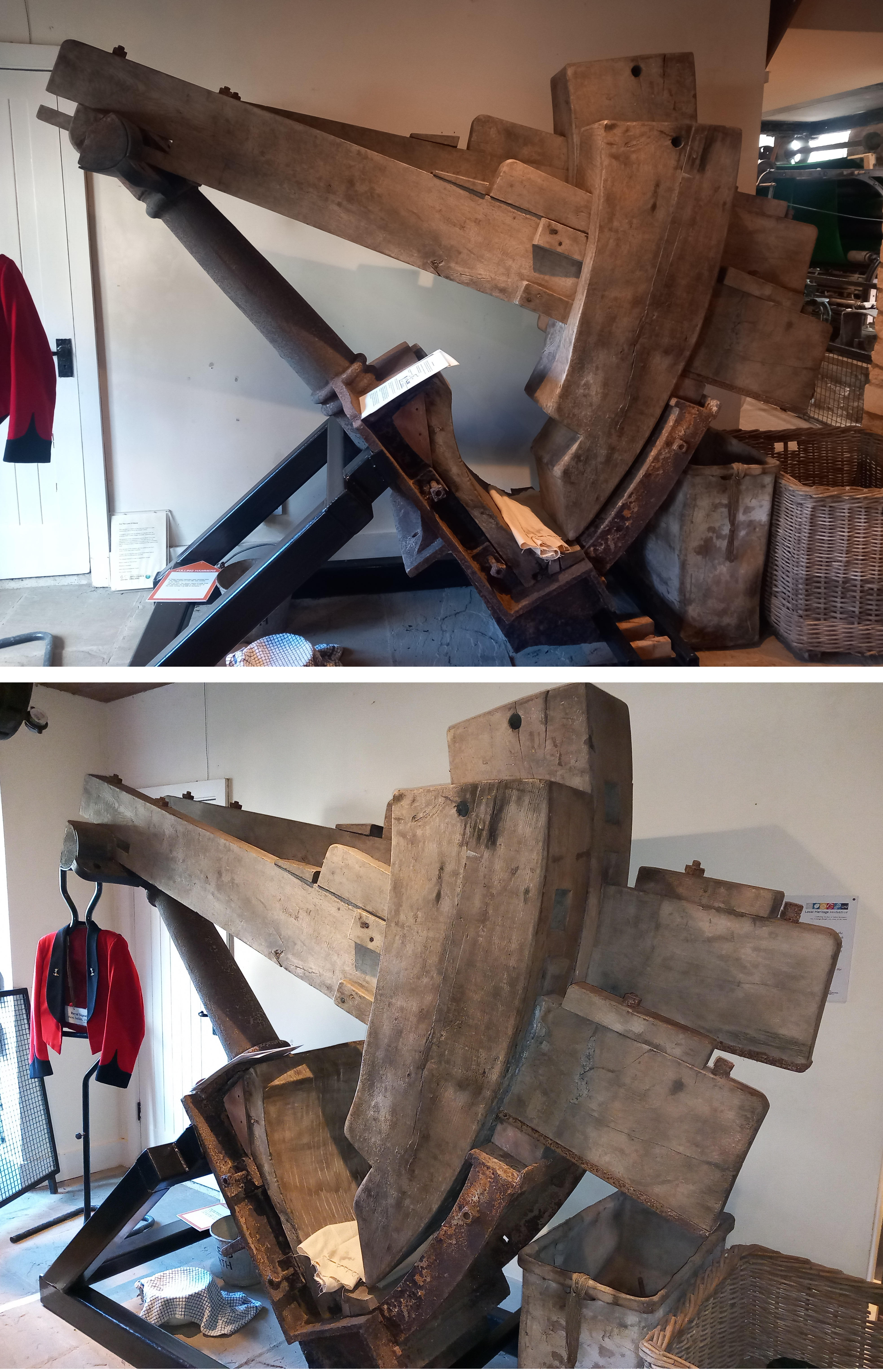
A surviving set of Fulling stock hammers, preserved at Dunkirk Mill, Nailsworth, Gloucestershire.
These were removed from a Mill at Cam near Dursley, which is about 10 miles from Thrupp.
The Cam wheel's beside the Thames and Severn Canal at Thrupp are also believed to come from the Cam Fulling stocks.
PublicationOriginal PhotographDate