
John Ferrabee's Patent No. 6058 for Improvements in Machinery for Woollen Cloths
Patent No. 6058
To JOHN FERRABEE, of the Thrupp Mill and Foundry, in the parish of Stroud, in the county of Gloucester, engineer, for his having invented improvements in machinery, for preparing the pile or face of woollen or other cloths requiring such process.-[Sealed 23rd December, 1830.]
THE object of this invention is to draw out the ends of wool, that is to raise the pile on woollen cloth in diagonal directions across the cloth, instead of raising it length- wise, as is the case in the ordinary gig mill.
In raising the pile on cloths it is desirable to draw out the ends of the wool in every direction, in order to cover the whole face of the cloth with nap as perfectly as possible, previously to its being submitted to the cropping or shearing operation. The ordinary gig mill will not effect this object completely, as it only draws out the wool in that direction that the cloth travels, and in con- sequence it is the practice of some clothiers, previous to shearing, to row or brush their cloths on the face with teasles or wire cards, by hand crosswise of the cloth, as well as submitting them to the operation of the gig mill.
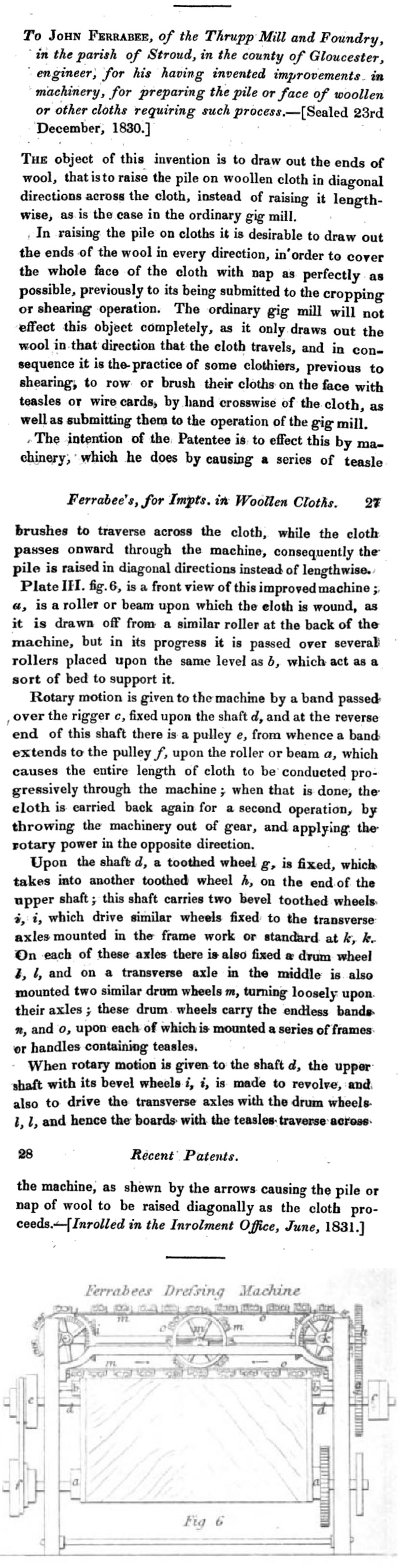
The intention of the Patentee is to effect this by machinery which he does by causing a series of teasle brushes to traverse across the cloth, while the cloth passes onward through the machine, consequently the pile is raised in diagonal directions instead of lengthwise. Plate III. fig. 6, is a front view of this improved machine; a, is a roller or beam upon which the cloth is wound, as it is drawn off from a similar roller at the back of the machine, but in its progress it is passed over several rollers placed upon the same level as b, which act as a sort of bed to support it.
Rotary motion is given to the machine by a band passed over the rigger c, fixed upon the shaft d, and at the reverse end of this shaft there is a pulley e, from whence a band extends to the pulley f, upon the roller or beam a, which causes the entire length of cloth to be conducted progressively through the machine; when that is done, the cloth is carried back again for a second operation, by throwing the machinery out of gear, and applying the rotary power in the opposite direction.
Upon the shaft d, a toothed wheel g, is fixed, which takes into another toothed wheel h, on the end of the upper shaft; this shaft carries two bevel toothed wheels i, i, which drive similar wheels fixed to the transverse axles mounted in the frame work or standard at k, k. On each of these axles there is also fixed a drum wheel , l, and on a transverse axle in the middle is also mounted two similar drum wheels m, turning loosely upon. their axles; these drum wheels carry the endless bands n, and o, upon each of which is mounted a series of frames or handles containing teasles.
When rotary motion is given to the shaft d, the upper shaft with its bevel wheels i, i, is made to revolve, and also to drive the transverse axles with the drum wheels 1, 1, and hence the boards with the teasles traverse across
Page 28 Recent Patents.
the machine, as shewn by the arrows causing the pile or nap of wool to be raised diagonally as the cloth proceeds. [ enrolled in the enrolment Office, June, 1831.]
PLATE 3 - FIG 6: Ferrabee's Dressing Machine - Diagram
PublicationPatent DocumentDateSourceGoogle Books/Newtons London Journal Arts Science/1832/P26Link