
The Management of Grass by Mr. T. Rutger.
One of the many contemporary articles appearing giving "expert" advice on lawns and lawncare. It is not clear from this article whether the author intends for the lawn to be mown with a lawnmower. However, by this time other writers were certainly mentioning the new machine.
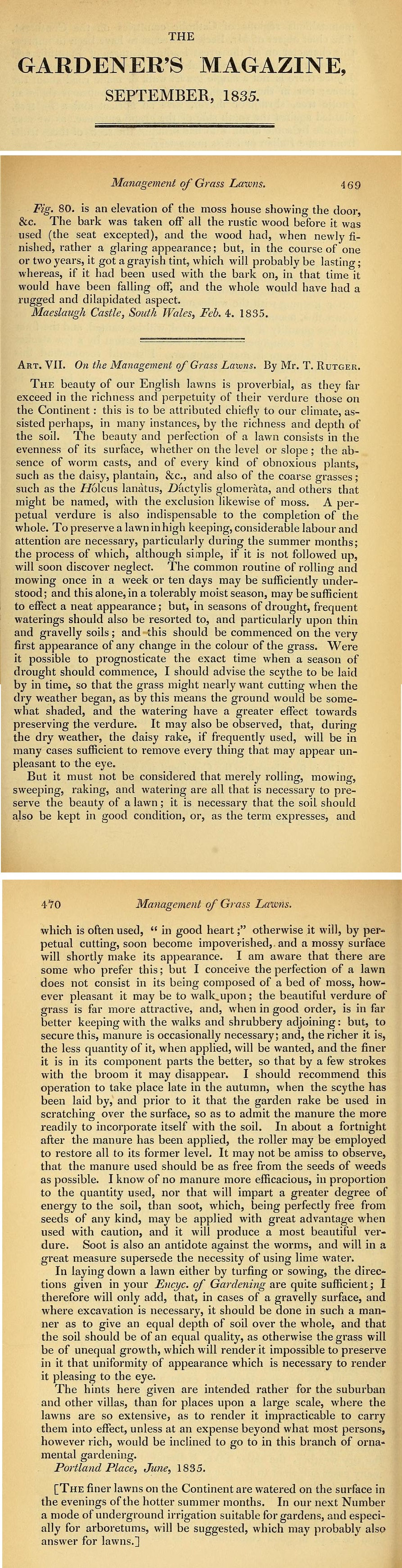
THE
GARDENER'S MAGAZINE,
SEPTEMBER, 1835.Page 469
ART. VII. On the Management of Grass Lawns. By Mr. T. RUTGER.
THE beauty of our English lawns is proverbial, as they far exceed in the richness and perpetuity of their verdure those on the Continent: this is to be attributed chiefly to our climate, assisted perhaps, in many instances, by the richness and depth of the soil. The beauty and perfection of a lawn consists in the evenness of its surface, whether on the level or slope; the absence of worm casts, and of every kind of obnoxious plants, such as the daisy, plantain, &c., and also of the coarse grasses; such as the Holcus lanatus, Dactylis glomerata, and others that might be named, with the exclusion likewise of moss. A perpetual verdure is also indispensable to the completion of the whole. To preserve a lawn in high keeping, considerable labour and attention are necessary, particularly during the summer months; the process of which, although simple, if it is not followed up, will soon discover neglect. The common routine of rolling and mowing once in a week or ten days may be sufficiently understood; and this alone, in a tolerably moist season, may be sufficient to effect a neat appearance; but, in seasons of drought, frequent waterings should also be resorted to, and particularly upon thin and gravelly soils; and this should be commenced on the very first appearance of any change in the colour of the grass. Were it possible to prognosticate the exact time when a season of drought should commence, I should advise the scythe to be laid by in time, so that the grass might nearly want cutting when the dry weather began, as by this means the ground would be some-what shaded, and the watering have a greater effect towards preserving the verdure. It may also be observed, that, during the dry weather, the daisy rake, if frequently used, will be in many cases sufficient to remove every thing that may appear unpleasant to the eye. But it must not be considered that merely rolling, mowing, sweeping, raking, and watering are all that is necessary to preserve the beauty of a lawn; it is necessary that the soil should also be kept in good condition, or, as the term expresses, and which is often used," in good heart;" otherwise it will, by perpetual cutting, soon become impoverished, and a mossy surface will shortly make its appearance. I am aware that there are some who prefer this; but I conceive the perfection of a lawn does not consist in its being composed of a bed of moss, however pleasant it may be to walk upon; the beautiful verdure of grass is far more attractive, and, when in good order, is in far better keeping with the walks and shrubbery adjoining: but, to secure this, manure is occasionally necessary; and, the richer it is, the less quantity of it, when applied, will be wanted, and the finer it is in its component parts the better, so that by a few strokes with the broom it may disappear. I should recommend this operation to take place late in the autumn, when the scythe has been laid by, and prior to it that the garden rake be used in scratching over the surface, so as to admit the manure the more readily to incorporate itself with the soil. In about a fortnight after the manure has been applied, the roller may be employed to restore all to its former level. It may not be amiss to observe, that the manure used should be as free from the seeds of weeds as possible. I know of no manure more efficacious, in proportion to the quantity used, nor that will impart a greater degree of energy to the soil, than soot, which, being perfectly free from seeds of any kind, may be applied with great advantage when used with caution, and it will produce a most beautiful verdure. Soot is also an antidote against the worms, and will in a great measure supersede the necessity of using lime water. In laying down a lawn either by turfing or sowing, the directions given in your Encyc. of Gardening are quite sufficient; I therefore will only add, that, in cases of a gravelly surface, and where excavation is necessary, it should be done in such a manner as to give an equal depth of soil over the whole, and that the soil should be of an equal quality, as otherwise the grass will be of unequal growth, which will render it impossible to preserve in it that uniformity of appearance which is necessary to render it pleasing to the eye. The hints here given are intended rather for the suburban and other villas, than for places upon a large scale, where the lawns are so extensive, as to render it impracticable to carry them into effect, unless at an expense beyond what most persons, however rich, would be inclined to go to in this branch of ornamental gardening.
Portland Place, June, 1835.
[THE finer lawns on the Continent are watered on the surface in the evenings of the hotter summer months. In our next Number a mode of underground irrigation suitable for gardens, and especially for arboretums, will be suggested, which may probably also answer for lawns.]
PublicationGardeners MagazineDateSourceBiodiversity Library/The Gardeners Magazine/1835/09/P469Link