
Hill and Son of Brierley Hill
An article in the 1853 edition of "The Artizan" outlines a lawnmower "manufactured" by Hill and Son of Brierley Hill, Staffordshire, England.
Hill & Son attended a number of Royal Agricultural Society of England (RASE) events where they exhibited Budding's original mower, made by John Ferrabee. This advertisement implies the company was manufacturing copies of the Registered Improvement Mower.
The engraving is, however, identical to the one used by John Ferrabee in the Gardeners' Chronicle during the 1852 season. This would imply that Ferrabee had supplied a printing block for use by Hill & Son and that the mower was, in fact, also made by Ferrabee and was simply resold by Hill & Son.
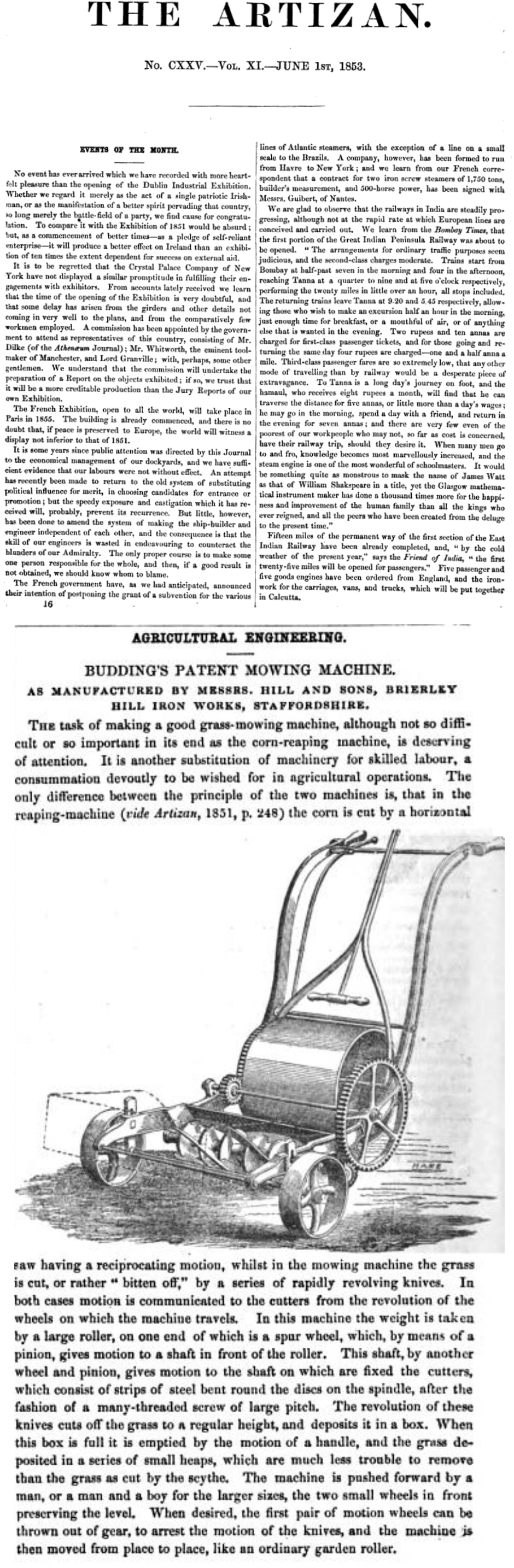
THE ARTIZAN.
No. CXXV.-VOL. XI.-JUNE 1ST, 1853.
BUDDING'S PATENT MOWING MACHINE.
AS MANUFACTURED BY MESSRS. HILL AND SONS, BRIERLEY HILL IRON WORKS, STAFFORDSHIRE.
THE task of making a good grass-mowing machine, although not so difficult or so important in its end as the corn-reaping machine, is deserving of attention. It is another substitution of machinery for skilled labour, a consummation devoutly to be wished for in agricultural operations. The only difference between the principle of the two machines is, that in the reaping-machine (ride Artizan, 1851, p. 248) the corn is sent by a horizontal saw having a reciprocating motion, whilst in the mowing machine the grass is cut, or rather" bitten off," by a series of rapidly revolving knives. In both cases motion is communicated to the cutters from the revolution of the wheels on which the machine travels. In this machine the weight is taken by a large roller, on one end of which is a spur wheel, which, by means of a pinion, gives motion to a shaft in front of the roller. This shaft, by another wheel and pinion, gives motion to the shaft on which are fixed the cutters, which consist of strips of steel bent round the discs on the spindle, after the fashion of a many-threaded screw of large pitch. The revolution of these knives cuts off the grass to a regular height, and deposits it in a box. When this box is full it is emptied by the motion of a handle, and the grass de- posited in a series of small heaps, which are much less trouble to remove than the grass as cut by the scythe. The machine is pushed forward by a man, or a man and a boy for the larger sizes, the two small wheels in front preserving the level. When desired, the first pair of motion wheels can be thrown out of gear, to arrest the motion of the knives, and the machine is then moved from place to place, like an ordinary garden roller.
PublicationOtherDateSourceGoogle Books/The Artizan/Vol11/1853/P128Link