Wilson Hartnell of Rodborough - Engineer at Phoenix Ironworks
This forgotten engineer and inventor started his career as a 15 year old at James & Henry Ferrabee's Phoenix Ironworks in 1854. According to this brief report he subsequently worked at some other very well known companies.
Additional information about his career can be found online on the Graces Guide website.

WILSON HARTNELL, ESQ., M.I.MECH.E., F.S.A., &c.
A carefully executed litho portrait, reproduced from a photograph, is issued as usual with this number of the MACHINERY MARKET as an extra supplement.
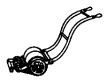
THE name of Mr. Wilson Hartnell is one of those most familiar to mechanical engineers. By his original work he has rendered important service to the steam engine, which stands indebted to him for an increase in efficiency and economy. For many years the problem of controlling the steady working of the steam engine under varying loads was a difficult one, and with the introduction of the electric light it became a matter of urgent necessity to devise a better system of governing. Although Mr. Hartnell's success in this direction is by no means the only work he has successfully accomplished, as the accompanying sketch will prove, he is entitled to honour amongst engineers on this account alone. Mr. Hartnell, moreover, is no mere theorist, he is, above all, a practical man, and has carried out his investigations to solid achievement. In reference to this, we may appropriately refer to the fact that his form of governor gear is recognised as a standard type, and is now very generally specified in engines of the best type.
Wilson Hartnell was born at Rodborough, Gloucestershire, and is the fourth son of the Rev. M. A. Hartnell, M.A. He commenced his engineering career at the Phoenix Iron Works, Stroud, in 1854, under the late Mr. James Ferrabee. Starting with the pattern shop he went through the works as turner, fitter, and erector, and after five years' experience he did a large portion of the firm's designing, and also took part in the management of the works. The principal manufactures of Messrs. Ferrabee consisted of steam engines, flour mill machinery, portable engines, and agricultural machinery, so that Mr. Hartnell had an all-round experience. The next five years of his career were chiefly occupied in the workshops of Messrs. Bryan, Donkin & Co., of Bermondsey, Messrs. John Penn & Co., of Greenwich, and Messrs. Sharp, Stewart & Co., of Manchester. In 1866 he became head draughtsman of the Lincoln Locomotive Works (then started by Messrs. Ruston, Proctor & Co.). After this he occupied the position of manager to the following firms:-Messrs. T. M. Tennant & Co., of Leith, Messrs. E. R. and F. Turner, of Ipswich, and Messrs. Tangye Bros., of Birmingham.
In 1876 Mr. Hartnell commenced business on his own account in Leeds, which he continues at the present time, as a consulting engineer. He also manufactures largely electrical and other machinery at the "Volt" Works, Leeds.
Whilst with Messrs. Ferrabee, Mr. Hartnell invented a machine for folding the light fleece combed off the doffer of a carding engine for making felt, and also for feeding other carding engines. the woo fibre being crossed, and each tuft of wool supplied to the first feed apron being spread over more than 90 deg. of this original area. A modification of this form of feed is now in general use. About the same time he invented several forms of variable expansion gear. One was founded on the epicycloidal curve, in which the expansion valve on the valve chest driven from a separate shaft made two revolutions for one of the crankshaft. This shaft was so arranged that by rolling it a certain angle round the crankshaft, both the lead and the eccentric and lap of the valve were suitably attained for early and late expansion. This was fitted on one of the competing engines exhibited at the Chester Show. It was adjusted by hand.
Another arrangement adjusted by the governor was applied to a compound condensing engine near Stroud, and also to an engine exhibited at the exhibition of 1862. The cut-off valve was a three-ported piston valve fixed on the steam chest, making two strokes for one of the engine. There were. two eccentrics on the countershaft with a link motion, whilst one eccentric rod was shorter than the other. This plant, we may mention, is still in use.
A further examination into the possible uses of cycloidal curves for valve motions led to the discovery that an excellent In Different Classes of Boilers," and also "On Governing" and his "Expansion Gear." This latter paper was read before the Institution of Mechanical Engineers.
Mr. Hartnell has been for about twenty years a member of the above institution, and is, besides, a member of local engineering societies. He is also an F.S. A. and a F.R.S.S.A.
PublicationOtherDateSourceGoogle Books/Machinery Market Magazine/1893/P327Link