
Richard Nicholson's Patent No 1627
This patent describes an unusual mechanism for delivering cut grass to either side of the machine using a system of belts. Although the patent appears to have been registered, as it was given a number, the inclusion of the wording "provisional protection" suggests that the application was not definitive. As article in the December 1862 edition of The Mechanics Magazine gives a brief description of the invention but also confirms that the patent application had been abandoned at some point.
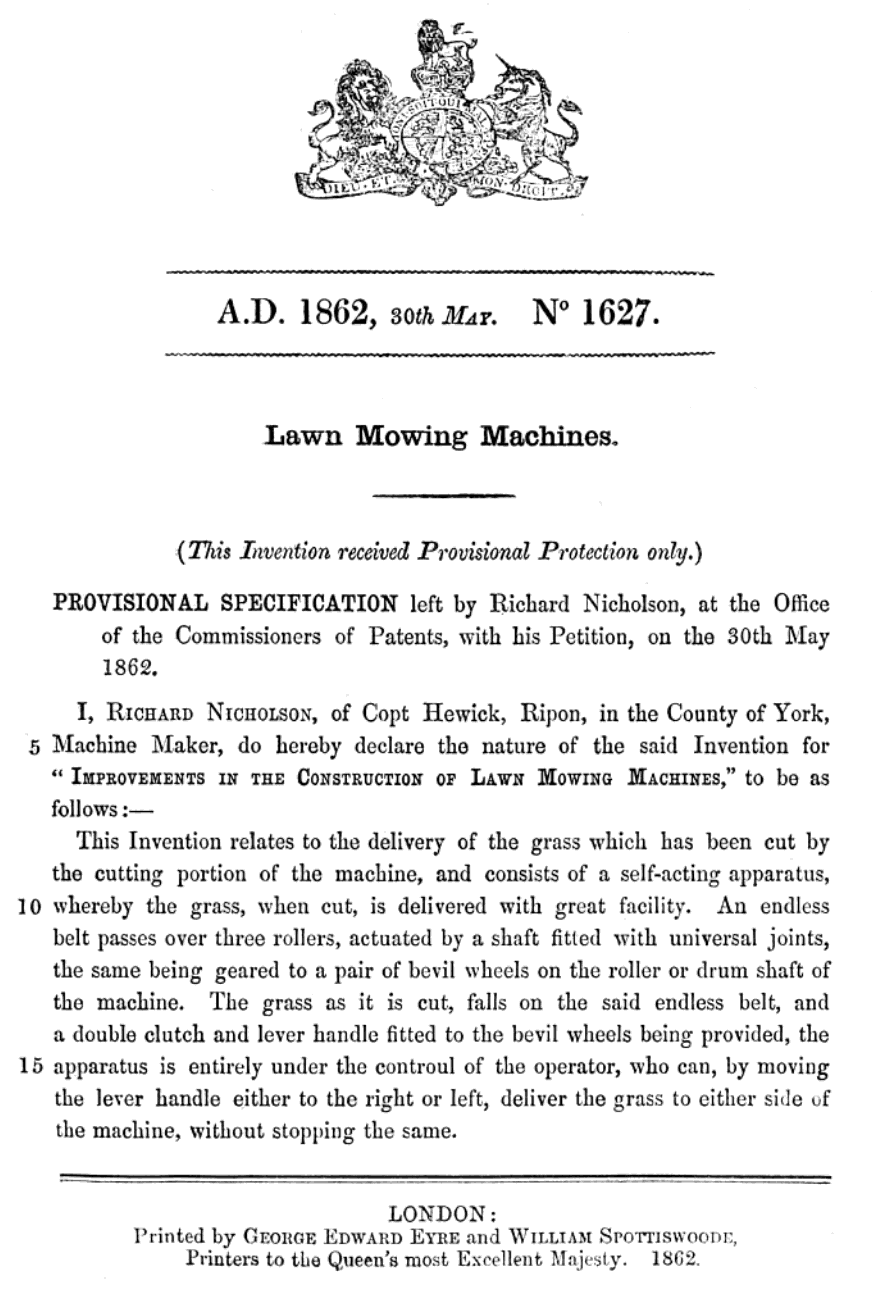
A.D. 1862, 30th MAY. N° 1627.
Lawn Mowing Machines.
(This Invention received Provisional Protection only.)
PROVISIONAL SPECIFICATION left by Richard Nicholson, at the Office of the Commissioners of Patents, with his Petition, on the 30th May 1862.
I, RICHARD NICHOLSON, of Copt Hewick, Ripon, in the County of York, 5 Machine Maker, do hereby declare the nature of the said Invention for "IMPROVEMENTS IN THE CONSTRUCTION OF LAWN MOWING MACHINES," to be as follows:-
This Invention relates to the delivery of the grass which has been cut by the cutting portion of the machine, and consists of a self-acting apparatus, 10 whereby the grass, when cut, is delivered with great facility. An endless belt passes over three rollers, actuated by a shaft fitted with universal joints, the same being geared to a pair of bevel wheels on the roller or drum shaft of the machine. The grass as it is cut, falls on the said endless belt, and a double clutch and lever handle fitted to the bevel wheels being provided, the 15 apparatus is entirely under the control of the operator, who can, by moving the lever handle either to the right or left, deliver the grass to either side of the machine, without stopping the same.
LONDON: Printed by GEORGE EDWARD EYRE and WILLIAM SPOTTISWOODE, Printers to the Queen's most Excellent Majesty. 1862.
PublicationPatent DocumentDateSourceGoogle Books/English Patents 1862/No 1627Link