
When Did "Budding's Patent" Lawnmower Have a Wooden Roller Fitted?
John Ferrabee's Registered Improvement No. 3074, as approved by the Patent Office on 2 January 1852, described what would now seem a logical step; the fitting of a point of contact in front of the cutting cylinder to stabilise the lawnmower and prevent the tendency of the cutting cylinder on the original Budding's Patent (1830-1851) to pitch down and dig into the turf.
The original improvement was to include two cast iron wheels on the side frames. This configuration allowed the grass to come in contact with the mowers cutting cylinder unobstructed, as on the original design.
Smaller Budding lawnmowers with the Registered Improvements had small side castors while the larger cut machines had visibly bigger wheels, the same or similar diameter as the rear roller. This can be seen in advertisements in The Gardeners' Chronicle and Agricultural Gazette magazine and surviving photographs. Examples include the Oxford College Improved Machine pictured in David Halford "Old Lawnmowers" Shire Album, the photograph of the Improved Mower at Charles Darwin's Down House, and the photograph of the Ransomes & Sims Improved machine of c1853-60 in the Ransomes archives.
So the question is when did manufacturers start fitting the front wooden roller that we know and recognise today?
James Ferrabee & Co.'s advertisement in the catalogue for the International Exhibition held in London between May and November 1862 shows an engraving with the side castors.
However, 12in machine (No 7508) which is believed to date from the late 1850s has a wooden roller fitted. So does a "Phoenix Iron Works Company" machine (No 8403) from c1862/3. Both these are displayed at The Museum in the Park, Stroud.
The only other surviving 12in "Budding's Improved", another James Ferrabee & Co. machine, No 7638, has its original side castors, identical to those seen on Ferrabee's Registered Design drawings and other engravings.
There is no definitive record of when full-width wooden front rollers were fitted to Budding mowers. It is possible that there was a period when both options were available, although no advertisement or other document mentions such an offer.
It is likely, therefore, that there was an abrupt change. Using the various clues outlined above it would seem possible, if not probable, that machine No 7508 had its current rollers fitted some time after it was manufactured. Its wooden rollers do not have the patina of items dating from 1857/8. By comparison, the youngest surviving mower built at The Phoenix Ironworks (No 8403) has rollers that show age and all of its other components also look original.
With no hard evidence it is impossible to be certain. James Ferrabee's exhibition block engraving from 1862 may not be up to date, as many block print typesets were used for many years during this period. Nevertheless, it is possible to estimate that mowers made at The Phoenix Ironworks had full-width front wooden rollers fitted from c1862/3 onwards.
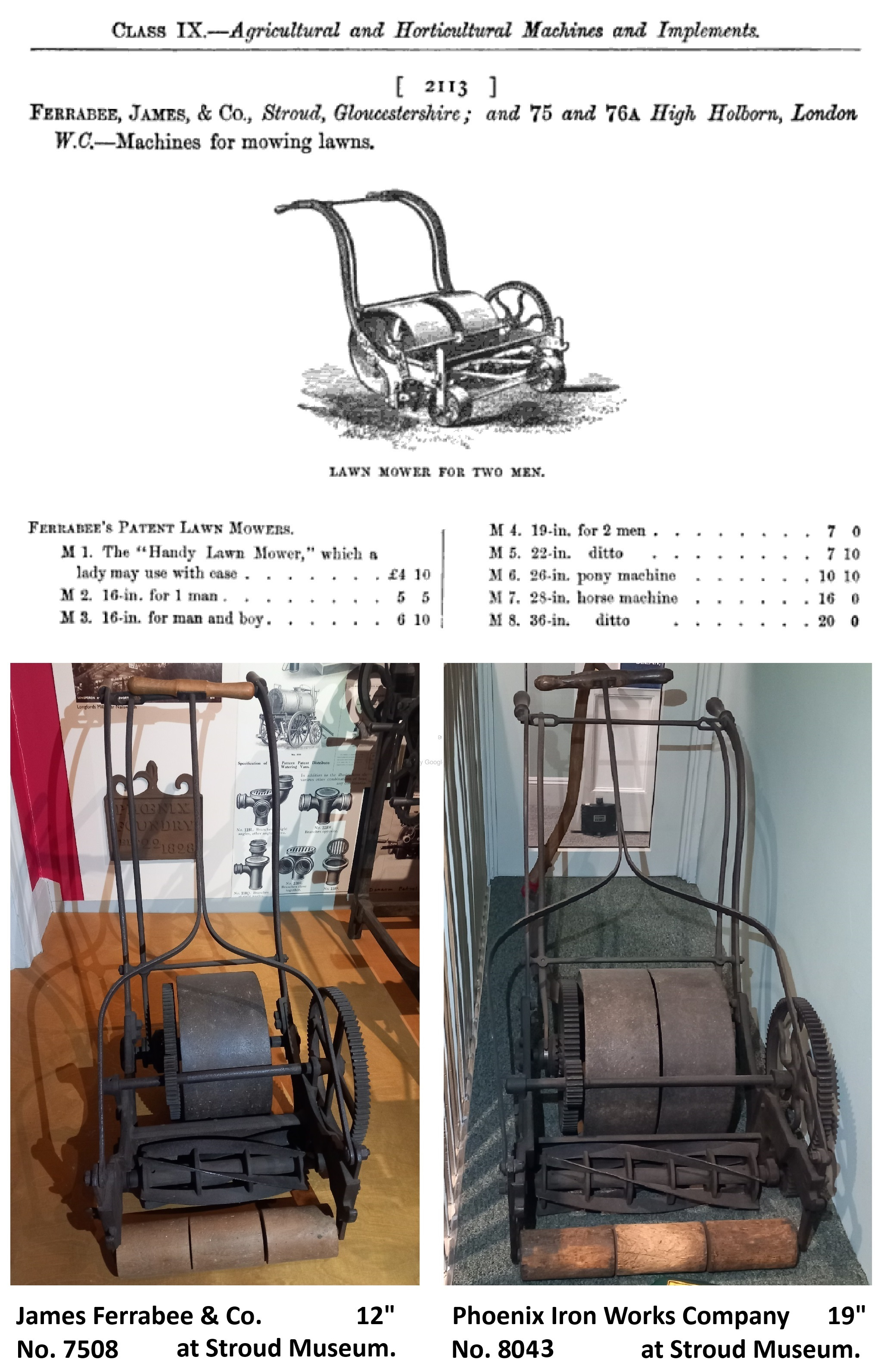
Extract from the catalogue of the 1862 International Exhibition held in London.
CLASS IX - Agricultural and Horticultural Machines and Implements [2113]
FERRABEE, JAMES & CO, Stroud, Gloucestershire; and 75 and 76A High Holborn, London, W.C. - Machines for mowing lawns.
FERRABEE'S PATENT LAWN MOWERS M4. 19-in. for 2 men £7 0 0 M1. The "Handy Lawn Mower," which a M5. 22-in. ditto £7 10 0 lady may use with ease £4 10 0 M6. 26-in. pony machine £10 10 0 M2. 16-in. for 1 man £5 5 0 M7. 28-in. horse machine £16 0 0 M3. 16-in. for man and boy £6 10 0 M8. 36-in ditto £20 0 0 Photographs
Left: James Ferrabee & Co., 12in, No 7508, Museum in the Park, Stroud.
Right: Phoenix Iron Works Company, 19in, No 8043, Museum in the Park, Stroud.
PublicationImage or PrintDate