
Smoothly Mown Grass at Littlecot Park in Wiltshire
Smoothly mown grass, possibly due to the switch from the scythe (or sheep) to the Budding's patent lawnmower. Certainly in the early days with the new mower costing £7 10s. and upwards, members of the landed gentry were the most important customers.
THE GARDENER'S MAGAZINE,
MAY, 1834.
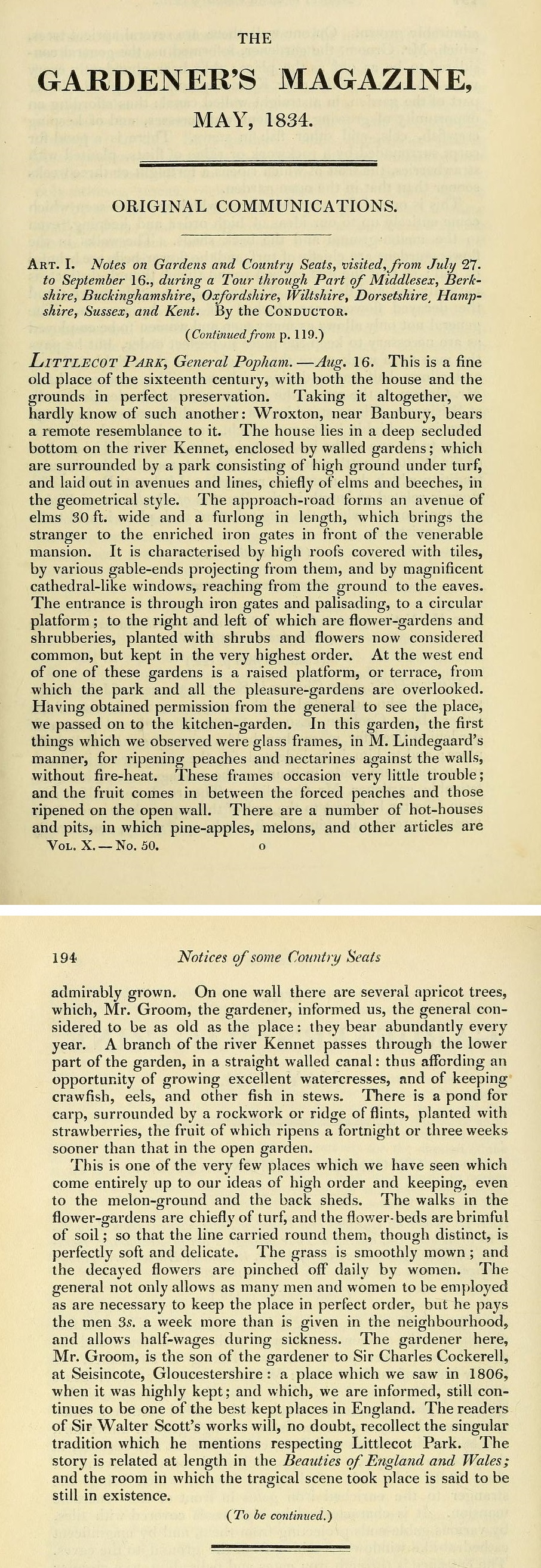
ORIGINAL COMMUNICATIONS.LITTLECOT PARK, General Popham.- Aug. 16. This is a fine old place of the sixteenth century, with both the house and the grounds in perfect preservation. Taking it altogether, we hardly know of such another: Wroxton, near Banbury, bears a remote resemblance to it. The house lies in a deep secluded bottom on the river Kennet, enclosed by walled gardens; which are surrounded by a park consisting of high ground under turf, and laid out in avenues and lines, chiefly of elms and beeches, in the geometrical style. The approach-road forms an avenue of elms 30 ft. wide and a furlong in length, which brings the stranger to the enriched iron gates in front of the venerable mansion. It is characterised by high roofs covered with tiles, by various gable-ends projecting from them, and by magnificent cathedral-like windows, reaching from the ground to the eaves. The entrance is through iron gates and palisading, to a circular platform; to the right and left of which are flower-gardens and shrubberies, planted with shrubs and flowers now considered common, but kept in the very highest order. At the west end of one of these gardens is a raised platform, or terrace, from which the park and all the pleasure-gardens are overlooked. Having obtained permission from the general to see the place, we passed on to the kitchen-garden. In this garden, the first things which we observed were glass frames, in M. Lindegaard's manner, for ripening peaches and nectarines against the walls, without fire-heat. These frames occasion very little trouble; and the fruit comes in between the forced peaches and those ripened on the open wall. There are a number of hot-houses and pits, in which pine-apples, melons, and other articles are admirably grown. On one wall there are several apricot trees, which, Mr. Groom, the gardener, informed us, the general considered to be as old as the place: they bear abundantly every year. A branch of the river Kennet passes through the lower part of the garden, in a straight walled canal: thus affording opportunity of growing excellent water cresses, and of keeping crawfish, eels, and other fish in stews. There is a pond for carp, surrounded by a rockwork or ridge of flints, planted with strawberries, the fruit of which ripens a fortnight or three weeks sooner than that in the open garden. The This is one of the very few places which we have seen which come entirely up to our ideas of high order and keeping, even to the melon-ground and the back sheds. The walks in the flower-gardens are chiefly of turf, and the flower-beds are brim-full of soil; so that the line carried round them, though distinct, is perfectly soft and delicate. The grass is smoothly mown; and the decayed flowers are pinched off daily by women. general not only allows as many men and women to be employed as are necessary to keep the place in perfect order, but he pays the men 3s. a week more than is given in the neighbourhood, and allows half-wages during sickness. The gardener here, Mr. Groom, is the son of the gardener to Sir Charles Cockerell, at Seisincote, Gloucestershire: a place which we saw in 1806, when it was highly kept; and which, we are informed, still continues to be one of the best kept places in England. The readers of Sir Walter Scott's works will, no doubt, recollect the singular tradition which he mentions respecting Littlecot Park. The story is related at length in the Beauties of England and Wales; and the room in which the tragical scene took place is said to be still in existence.
PublicationGardeners MagazineDateSourceBiodiversity Library/The Gardeners Magazine/1834/P183-194Link