
Second Manufacturer
Articles published in the Gardeners' Chronicle and elsewhere in early 1842 announced the arrival of a new manufacturer with a different design of lawnmower.
Having seen and perhaps used a Budding Patent lawnmower at his extensive estate at Kinblethmont in Scotland, W F Lindsay-Carnegie (well known for his enthusiasm for gardening and engineering among other topics) decided that he needed something bigger. He approached an engineer called Alexander Shanks who had recently set up business in nearby Arbroath. Working to the design of a Mr Talbot, Shanks produced a machine with a 27 inch cutting width, significantly larger than the Budding models being produced solely at the time by John Ferrabee in Stroud.
This new mower was, like the Budding, driven by gears and incorporated the helical-bladed cutting cylinder, with components made from cast and wrought iron. Its size and weight required that it should be pulled by a horse or pony, with an operator controlling the machine and animal from the rear.
Articles and letters by Lindsay Carnegie published in 1842 confirm that the new mower was tested by him at his estate during 1841. He was clearly impressed by the results and asked Shanks to produce an even larger version, with 42 inch cutting width. This model became the basis of a small but growing range of lawnmowers introduced by Shanks in the following years. Shanks therefore became the second manufacturer to produce its own design of mower over ten years after Budding's design was first manufactured by Ferrabee. In addition to the speed at which the new lawnmower could cover a large area, Lindsay Carnegie foresaw that the inclusion of wider rollers and the size of the machine would offer the benefit of rolling the lawn as well as cutting the grass. This had not up to the time been claimed as an advantage of these new machines.
Another innovation on the new mower was the addition of a second axle, mounted behind the cutter and in front of the rear roller. The idea was for the wheels on this axle to provide stability and help prevent the mower pitching downwards, thereby reducing considerably the tendency for the cutting mechanism to dig into the turf. It is not known whether the axle and wheels were present on the prototype but they were certainly part of the "production" model in 1842 and were presumably described on the documents registered by Shanks as patent No. 1365 in Scotland.
At this time, nobody had thought to fit rollers or wheels at the very front of the machine - the first mowers to do so would appear as late as 1852 when John Ferrabee introduced new "Registered Improvements" under patent No. 3074.
One of the reasons that Shanks was able to produce a mower which had many features in common with the Budding design was that Ferrabee and Budding had only registered the patent in England: at the time Scotland had its own patent system and protection was not automatically extend to the other country.
It is not known how or why Ferrabee and Budding made this supposed error. It is possible that they did not foresee the need, believed registration in a second country was too complicated, or had assumed that registration in England was suffice. Nevertheless, reports from later in 1842 confirm that Ferrabee was aware of the new mower and had visited Scotland to see it for himself. He then apparently came to an arrangement with Shanks to allow the machine to be sold in England.
The business of Alexander Shanks and Son grew rapidly although Alexander himself did not live to see its full success. When he died in 1845 his son James took the reigns. Over the next 50 years and more the business grew to be one of the biggest of its type, producing not only lawnmowers but a whole range of machines and items associated with the engineering boom of the Victorian era.
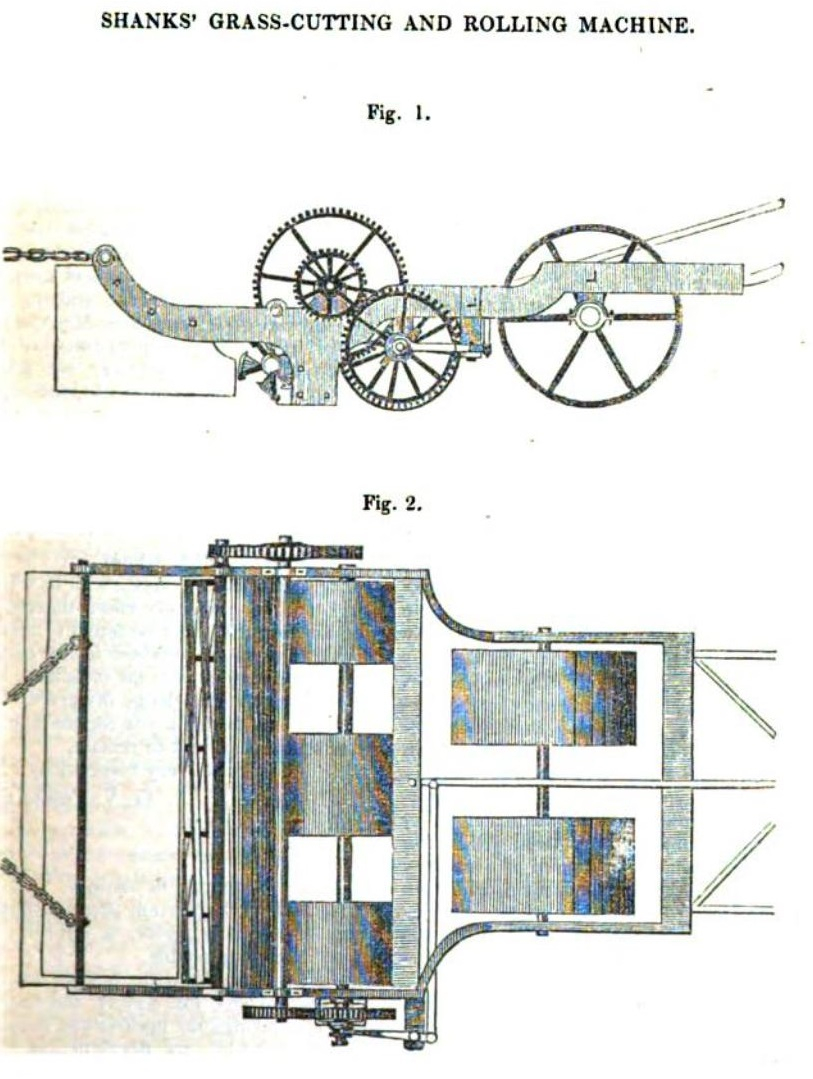
Drawings showing Shanks mower.
PublicationImage or PrintDateSourceWest Bengal Public Library/Internet Archive/Mechanics Magazine/VOL37/1842/P66Link