
Description of Budding Mower in Another Patents Book
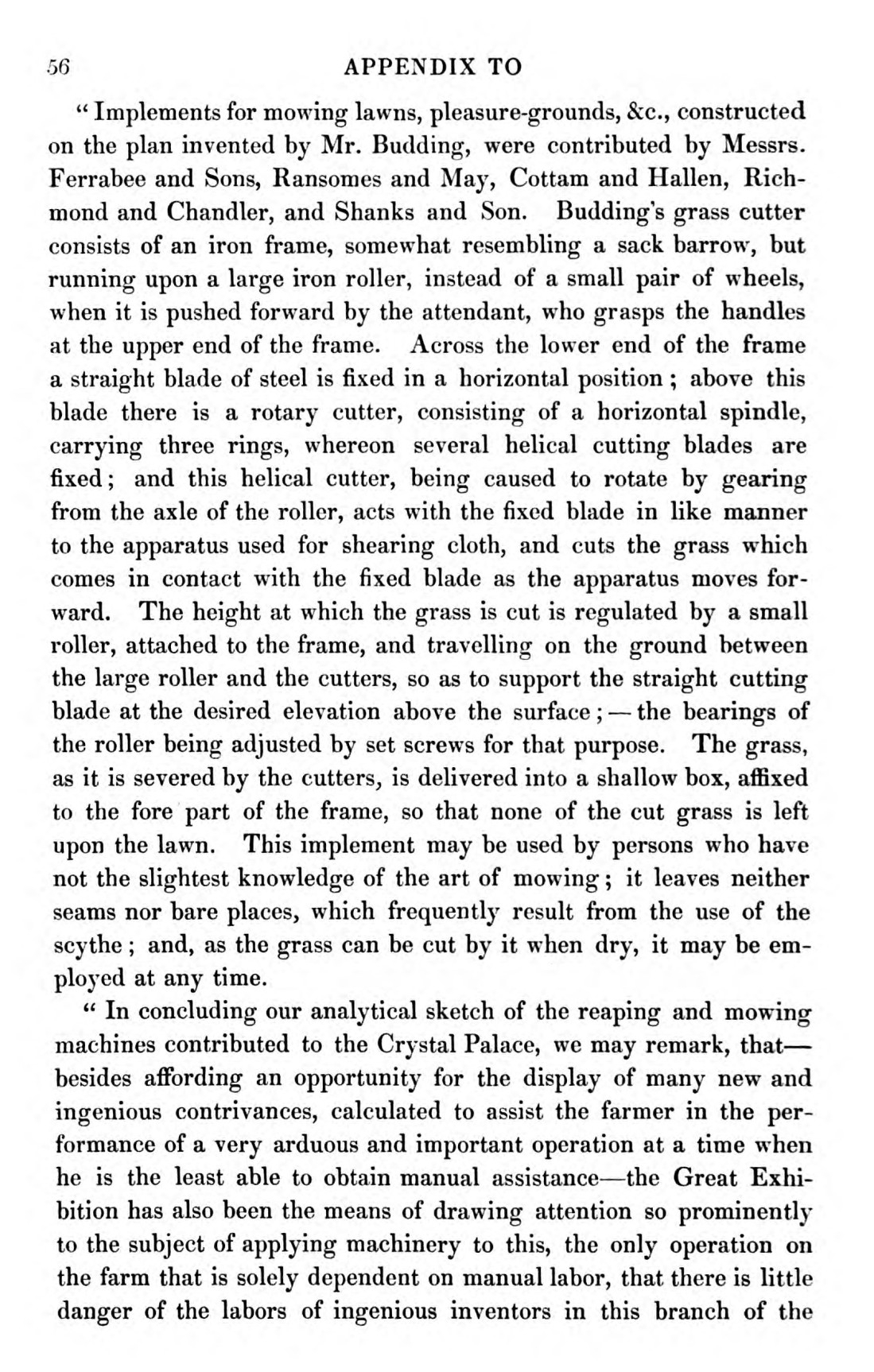
An extract from a book published in 1853 on the development or reapers and mowers outlines the broad configuration and action of the original Budding Patent Lawnmower and references the Great Exhibition of 1851. The description mentions the method of cutting height adjustment and the position of the intermediate roller as being between the rear roller and cutter mechanism.
By the time this book was published the original mower design was well over 20 years old and had in fact been superseded by several improvements made by Ferrabee and other manufacturers, some of whom the article mentions.
APPENDIX TO THE SPECIFICATIONS OF ENGLISH PATENTS FOR Reaping Machines. BY BENNET WOODCROFT,
SUPERINTENDENT OF THE SPECIFICATIONS IN THE PATENT OFFICE, AND LATE PROFESSOR OF MACHINERY IN UNIVERSITY COLLEGE, LONDON.
Published under the Sanction of the Commissioners of Patents, By GEORGE EDWARD EYRE and WILLIAM SPOTTISWOODE, Printers to the Queen's Most Excellent Majesty.
1853.
PAGE 56:
"Implements for mowing lawns, pleasure-grounds, &c., constructed on the plan invented by Mr. Budding, were contributed by Messrs. Ferrabee and Sons, Ransomes and May, Cottam and Hallen, Rich- mond and Chandler, and Shanks and Son. Budding's grass cutter consists of an iron frame, somewhat resembling a sack barrow, but running upon a large iron roller, instead of a small pair of wheels, when it is pushed forward by the attendant, who grasps the handles at the upper end of the frame. Across the lower end of the frame a straight blade of steel is fixed in a horizontal position; above this blade there is a rotary cutter, consisting of a horizontal spindle, carrying three rings, whereon several helical cutting blades are fixed; and this helical cutter, being caused to rotate by gearing from the axle of the roller, acts with the fixed blade in like manner to the apparatus used for shearing cloth, and cuts the grass which comes in contact with the fixed blade as the apparatus moves for- ward. The height at which the grass is cut is regulated by a small roller, attached to the frame, and travelling on the ground between the large roller and the cutters, so as to support the straight cutting blade at the desired elevation above the surface; - the bearings of the roller being adjusted by set screws for that purpose. The grass, as it is severed by the cutters, is delivered into a shallow box, affixed to the fore part of the frame, so that none of the cut grass is left upon the lawn. This implement may be used by persons who have not the slightest knowledge of the art of mowing; it leaves neither seams nor bare places, which frequently result from the use of the scythe; and, as the grass can be cut by it when dry, it may be em- ployed at any time.
—
"In concluding our analytical sketch of the reaping and mowing machines contributed to the Crystal Palace, we may remark, that- besides affording an opportunity for the display of many new and ingenious contrivances, calculated to assist the farmer in the performance of a very arduous and important operation at a time when he is the least able to obtain manual assistance the Great Exhibition has also been the means of drawing attention so prominently to the subject of applying machinery to this, the only operation on the farm that is solely dependent on manual labuor, that there is little danger of the labours of ingenious inventors in this branch of the
PublicationPatent DocumentDateSourceGoogle Books/Hathi Trust/Appendix to Specifications of English Patents for Reaping Machines/1853/P56Link